Publications
Ordered by most recent († indicates equal contribution).
2026
-
 Multimaterial hybrid additive manufacturing of smart polymer structures with embedded electronicsJaehun Jeon, SK Shamim Hasan Abir, Shinan Huang, and 6 more authorsACS Applied Electronic Materials, Nov 2026
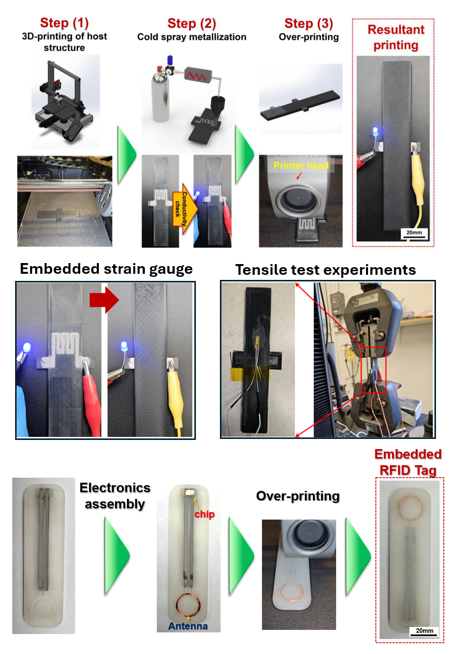
Additive manufacturing (AM) provides a promising route for integrating electronic functionalities into polymer structures. However, existing approaches often rely on strong chemicals, post-processing, or assembly steps that limit design flexibility, manufacturing efficiency, and electrical reliability. This study presents a multimaterial hybrid AM strategy that integrates fused filament fabrication with cold spray additive manufacturing (CSAM) to fabricate polymer structures with embedded functionality. Tin (Sn) electrodes were directly deposited onto 3D-printed polymer substrates via CSAM and subsequently encapsulated through polymer over-printing, eliminating the need for surface pretreatment, thermal sintering, chemical metallization, or adhesive bonding. A systematic design of experiments with microstructural characterization established the process–structure–property relationships governing polymer metallization, identifying the optimal processing conditions for producing continuous conductive pathways with an electrical conductivity of 3.76 × 10⁵ S·m–1. The versatility of the proposed approach was demonstrated through three representative fully embedded smart structures: (i) a strain sensor with a gauge factor of 2.766; (ii) a triboelectric nanogenerator (TENG) capable of generating a peak output voltage of ∼65 V and a peak power density of 3 μW cm–2; and (iii) a radio-frequency identification (RFID) circuit. These results provide a pathway toward smart polymer electronics (plastronics) for next-generation engineering systems.
-
 Lunar regolith simulant-based triboelectric nanogenerators via solid-state additive manufacturingSazedur Rahman, Sk Shamim Hasan Abir, Dominik Fritz, and 2 more authorsApplied Materials Today, Nov 2026
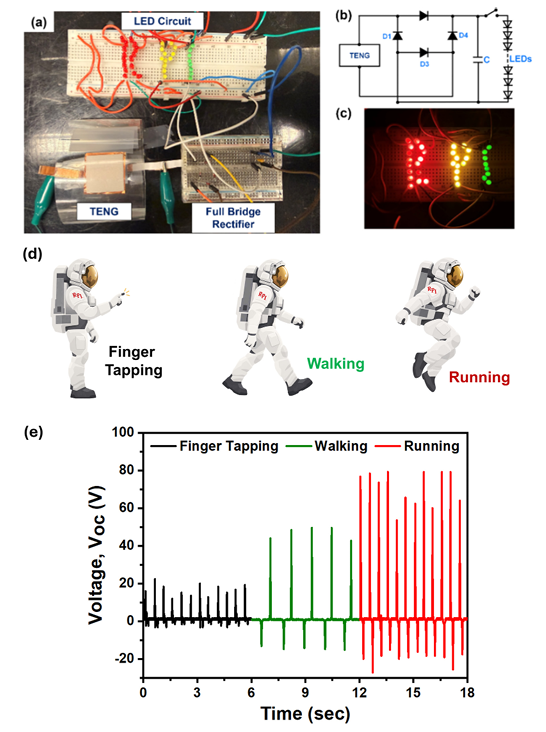
For future lunar missions, in-situ resource utilization (ISRU) is essential to reduce reliance on Earth-based supply chains and enable sustained human presence beyond Earth. Realizing this vision critically depends on the efficient on-site energy harvesting from locally available extraterrestrial materials, such as lunar regolith. Utilizing regolith as a functional material can enable autonomous, self-powered systems for sustained surface operations while reducing logistical complexity. In parallel with this vision, this study develops lunar regolith simulant-based triboelectric nanogenerators (TENGs) using a solid-state additive manufacturing approach. Engineered regolith/metal composite powders (50–80 wt% regolith) are synthesized and deposited onto polytetrafluoroethylene (PTFE) substrate using cold spray additive manufacturing (CSAM) to fabricate high-performance, mechanically robust triboelectric layers. The resulting layers exhibit electrical conductivity up to ∼4.9×10⁵ S.m−1, with thicknesses ranging from 16 to 40μm. Furthermore, radiation testing using a high-power linear accelerator confirmed the radiation resistance of the fabricated triboelectric layers, along with their strong interfacial adhesion strength. Notably, under cyclic contact–separation loading, the lunar-based TENG (with 50 wt% regolith) achieves an open-circuit voltage (Voc) of 142 V and a short-circuit current (Isc) of 17.6μA. Moreover, a power density of 81.3μW/cm2 is obtained, representing a significant improvement (∼27-fold) over previously reported lunar regolith-based TENGs. The fabricated TENGs also maintain stable energy-harvesting performance over 5000 cycles, demonstrating excellent durability and reliability. This work presents the first proof-of-concept demonstration of CSAM-enabled lunar regolith-based TENGs with promising performance, offering a viable pathway toward durable, in-situ energy-harvesting systems for future lunar missions.
-
 Data-driven prediction of cold spray additive manufacturing via CFD-guided machine learningFatema Tuj Zohora, Jaehun Jeon, and Semih AkinResults in Engineering, Nov 2026
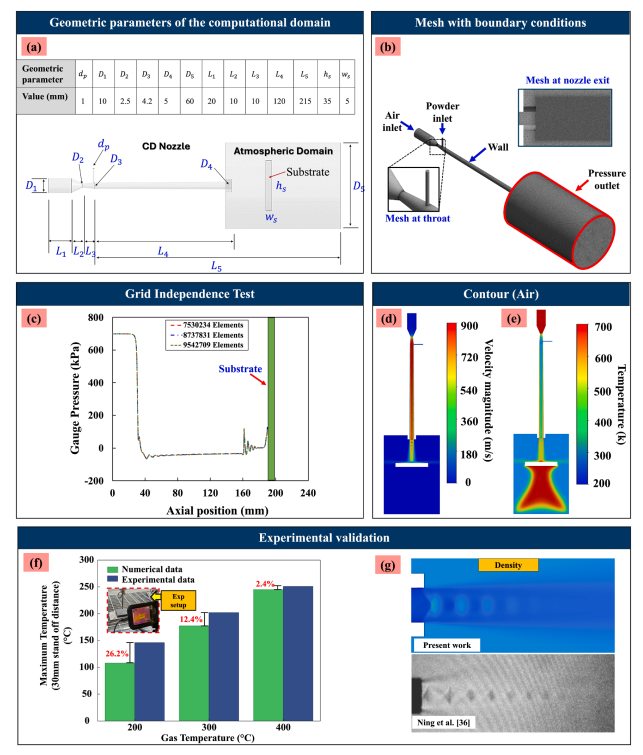
Cold spray additive manufacturing (CSAM) has emerged as a promising solid-state manufacturing technique for fabricating metallic components and functional coatings. However, experimentally predicting particle impact properties (e.g., impact velocity, impact temperature) and correlating them with deposition state remains challenging due to the complex interactions among process parameters, gas dynamics, and particle behavior during deposition. These characteristics play a critical role in determining deposition efficiency (DE) and the quality of the deposited material, thereby highlighting the need for predictive modeling frameworks. In this study, a computational-fluid dynamics (CFD)-guided machine learning framework is developed to correlate CSAM input parameters (i.e., gas pressure, gas temperature, particle size) with deposition state (i.e., deposition/no deposition) and DE. Three-dimensional CFD simulations are conducted under varying gas pressures, gas temperatures, and particle sizes based on a design of experiments (DoE) to generate a particle-level dataset. The generated dataset is then used to train machine learning (ML) models for both classification and regression analysis. Logistic Regression (LR), Support Vector Machine (SVM), Random Forest (RF), and Neural Network (NN) models are implemented for deposition state prediction, while Ridge Regression (RR) and Gaussian Process Regression (GPR) models are employed for DE (%) prediction, enabling a comparative evaluation of ML model performance. Among the classification models, SVM and RF achieved the highest deposition state prediction accuracy of ∼ 98.5%, while GPR demonstrated better agreement with the CFD-generated DE trends, achieving a testing R2 of 0.896. The findings highlight the potential of CFD-driven ML approaches for improving deposition prediction in CSAM, with significant potential to advance data-driven process modeling and intelligent manufacturing.
-
 A convergent manufacturing pathway for smart metallic structures with embedded sensingJinhan Ren, Shinan Huang, Sazedur Rahman, and 8 more authorsProgress in Additive Manufacturing, Nov 2026
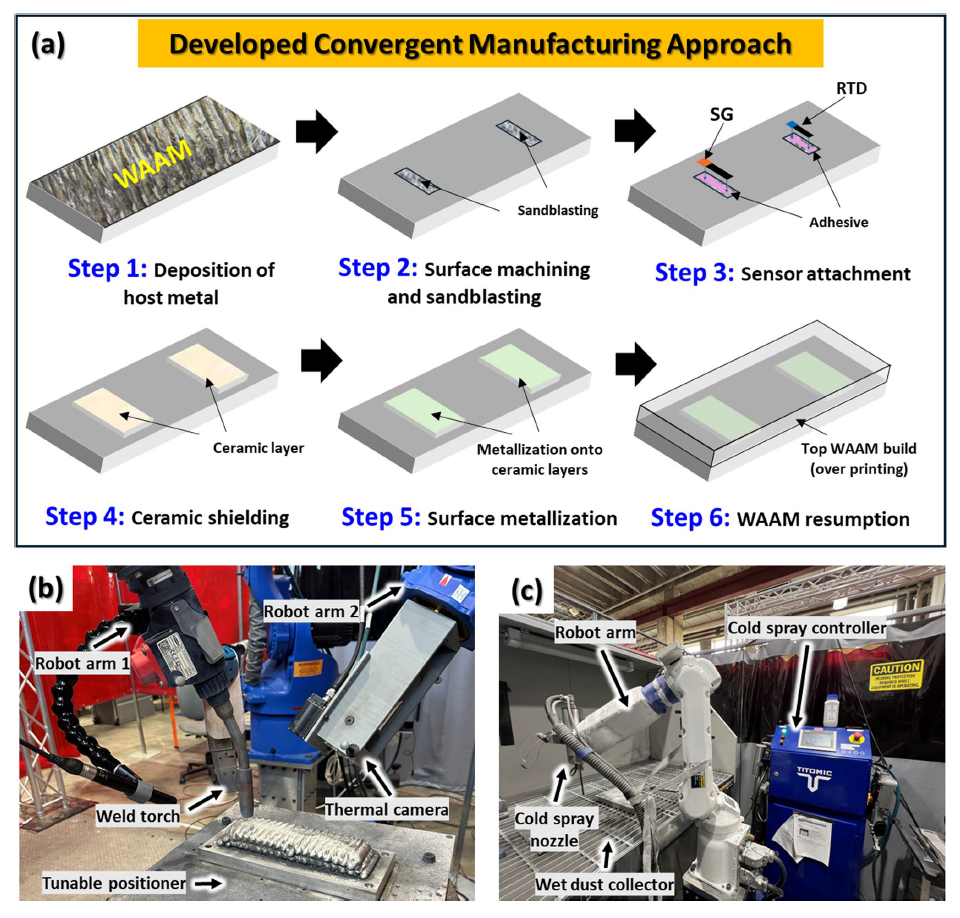
Smart metallic structures (SMS) with embedded sensors are gaining significant interest as they enable real-time sensing and structural monitoring in mission-critical applications. However, integrating sensors directly into metallic materials remains challenging due to the extreme thermal loads and metallurgical incompatibilities inherent to metal additive manufacturing (MAM). To address this gap, this study introduces a convergent manufacturing pathway that integrates wirearc additive manufacturing (WAAM), subtractive machining, ceramic sensor shielding, and cold spray metallization to realize smart metallic structures with fully embedded sensing capabilities. The developed sensor encapsulation approach, combining ceramic shielding with cold spray metallization, enables seamless WAAM deposition over the sensor regions and allows the embedding of commercial off-the-shelf (COTS) sensors in structural aluminum alloy beams (Al-5356), resulting in fully functional smart beams. Unlike prior studies that typically demonstrate a single sensing modality with single-sensor embedding, this work integrates a dense multi layer and multi modal sensor network featuring multiple sensor configurations within a standard bending beam footprint (180 mm $\times20 mm \times$13 mm). This represents a significant advancement in both sensor density and integration fidelity for MAM. Comprehensive thermal and mechanical experiments confirm that the embedded sensors remain fully functional and accurate throughout testing. The temperature sensors (RTDs) capture both steady-state and transient thermal responses with less than 2.2% error, while the strain gauges provide high-fidelity measurements with deviations below 2.5%. Furthermore, the fabricated smart beams exhibit a mechanical debit of less than 11% under static bending and less than 20% under dynamic bending relative to baseline beams without embedded sensors, while maintaining full structural and sensing integrity. This work establishes a convergent manufacturing pathway that enables reliable sensor embedding under the demanding conditions of MAM and marks a significant step toward next-generation SMS.
-
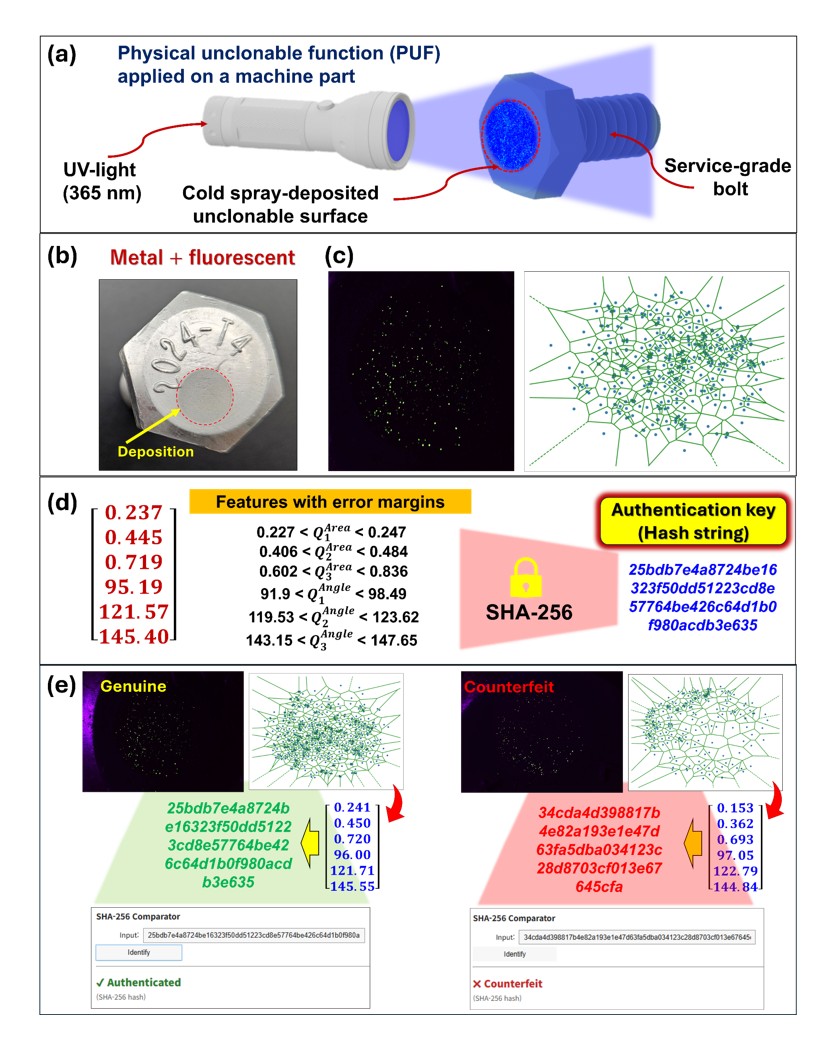 Physically unclonable surfaces enabled by cold spray depositionJaehun Jeon, and Semih AkinACS Applied Materials & Interfaces, Nov 2026
As counterfeit components become increasingly prevalent, encoded surfaces, particularly physically unclonable functions (PUFs), have emerged as powerful tools for secure part authentication and reliable traceability. However, significant challenges remain in fabricating unclonable surface structures in a high-throughput, scalable, and cost-effective manner while also ensuring robust encryption and secure authentication. This work aims to address the existence gaps by introducing an innovative approach to PUF manufacturing utilizing the cold spray (CS) particle deposition technique, complemented by algorithmic feature extraction and cryptographic surface encoding. In our approach, a mixture of metal and fluorescent microparticles is deposited onto an aluminum (Al 5052) substrate by leveraging the process-specific two-phase (gas–solid) turbulent flow characteristic of the CS process. The inherent stochasticity of the CS flow leads to a random distribution of fluorescent particles, generating unique, physically unclonable luminescent patterns on the target surface. The spatial distribution of the optical fluorescent particles is then captured under UV light (365 nm) exposure and subsequently processed through image binarization. Features are extracted from this distribution by using Voronoi analysis. The extracted features are then encrypted using the SHA-256 cryptographic algorithm to generate a secure “certification key” for part authentication. Experimental results demonstrate the effectiveness of the proposed manufacturing approach for high-throughput, scalable PUF production, confirming its suitability for robust part authentication and its reliability under environmental stressors (e.g., thermal cycling, chemical exposure). The developed method shows strong potential for enabling tamper-evident part authentication solutions to address the growing threat of counterfeiting in critical sectors, such as aerospace, defense, and advanced manufacturing.
-
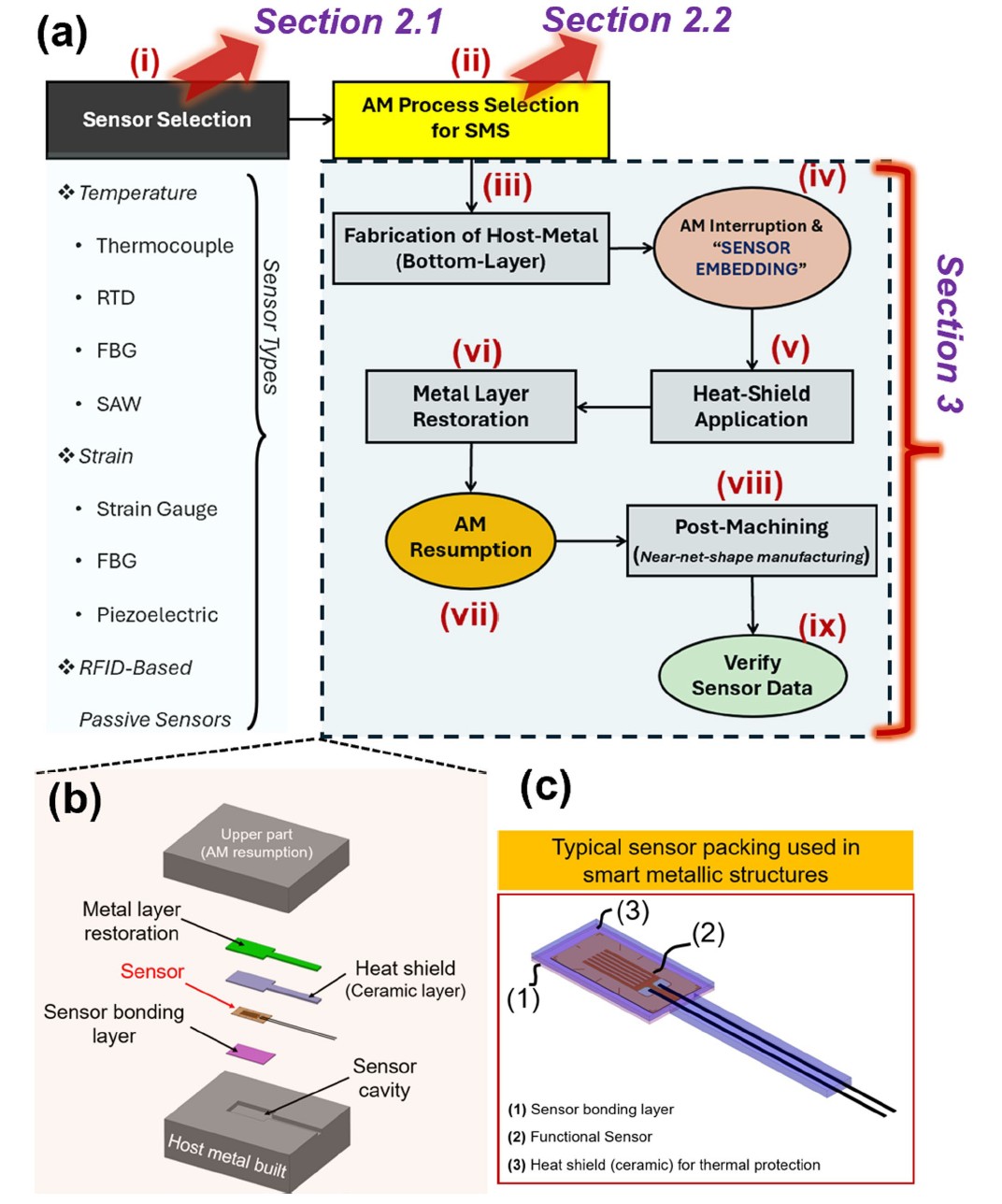 Additively manufactured smart metallic structures with embedded sensing: a reviewSazedur Rahman, Semih Akin, Jinhan Ren, and 3 more authorsProgress in Additive Manufacturing, Nov 2026
The integration of sensors into metallic structures has gained significant attention, leading to the emergence of “Smart Metallic Structures (SMS).” These structures feature embedded sensors designed for real-time data acquisition of functional signals (e.g., strain, temperature, pressure, humidity) for structural monitoring. Notably, the advent of metal additive manufacturing (AM) technologies has enabled the direct embedding of functional sensors into metallic components, making a transformative step toward fully integrated smart structures. This capability is particularly valuable for critical applications where continuous monitoring is vital to ensure safety, efficiency, durability, and improved performance. Despite rapid progress, there remains a need for a comprehensive review that systematically summarizes sensor-embedding strategies, material–process interactions, performance evaluation methods, and key challenges. This review addresses that gap by synthesizing recent developments in additively manufactured SMS and elucidating how AM technologies are being leveraged to integrate sensing functionalities. The objectives of this work are to: (i) consolidate recent advancements; (ii) provide a nuanced perspective on the current landscape of sensor-embedded SMS; and (iii) identify key research challenges to guide future work and facilitate broader adoption. Unlike prior reviews that primarily focus on either AM techniques or standalone sensor technologies, this work presents a holistic framework linking materials, manufacturing processes, and sensing performance. By mapping current progress and outlining emerging opportunities, this review aims to guide both researchers and industry practitioners toward the development of next-generation intelligent metallic systems.


2025
-
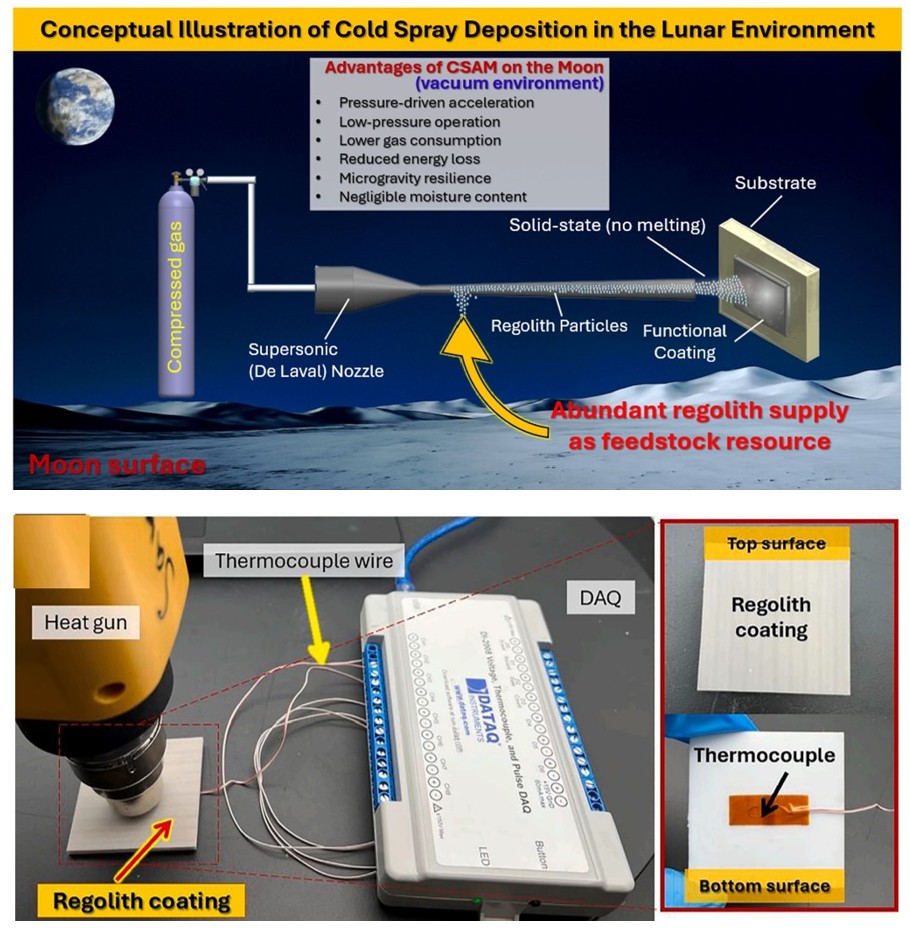 Cold spray deposition of lunar regolith on polymeric substrates: A pathway toward in-situ resource utilization on the MoonSazedur Rahman, and Semih AkinSurfaces and Interfaces, Nov 2025
In-Situ Resource Utilization (ISRU) plays a crucial role in reducing the cost of lunar exploration and minimizing reliance on Earth-supplied material, both are essential for sustainable human activities on the Moon. In this context, lunar regolith serves as a key source for ISRU in lunar exploration, supporting applications such as manufacturing, construction, shielding, and so on. In particular, the development of functional coatings from regolith is crucial for enhancing component performance and enabling sustainable in-situ repair in space environments. While efforts have been done to investigate lunar regolith deposition on metals, studies on polymeric substrates remains largely limited, thereby highlighting the need for innovative approaches in this domain. This study explores the use of Cold Spray Additive Manufacturing (CSAM) to deposit lunar regolith simulant onto polymeric substrates, with the aim of developing functional coatings that can advance future ISRU efforts on the Moon. In this regard, CSAM of regolith simulant (LHS-1D) on polytetrafluoroethylene (PTFE) substrate is studied, as PTFE is widely used in space applications for its desired properties (e.g., chemical resistance, thermal stability, low-friction). A comprehensive design of experiments was implemented to investigate the process–structure–property relationships of CSAM and to identify optimal process settings. The resulting coatings are characterized in terms of microstructure, mechanical properties, hardness, adhesion strength, and thermal resistance to holistically assess their performance. The as-CSAM specimens developed regolith coatings (12–23μm) with excellent adhesion (5B per ASTM D3359 and ∼ 9–12 MPa from pull-off tests), while largely preserving their mechanical properties. In addition, the fabricated regolith coatings improved the thermal resistance (∼ 8.25%) compared with pristine PTFE. This work represents the first attempt to evaluate the feasibility of CSAM for producing coatings from lunar regolith on polymeric substrates, with the goal of supporting space manufacturing and long-term lunar missions.
-
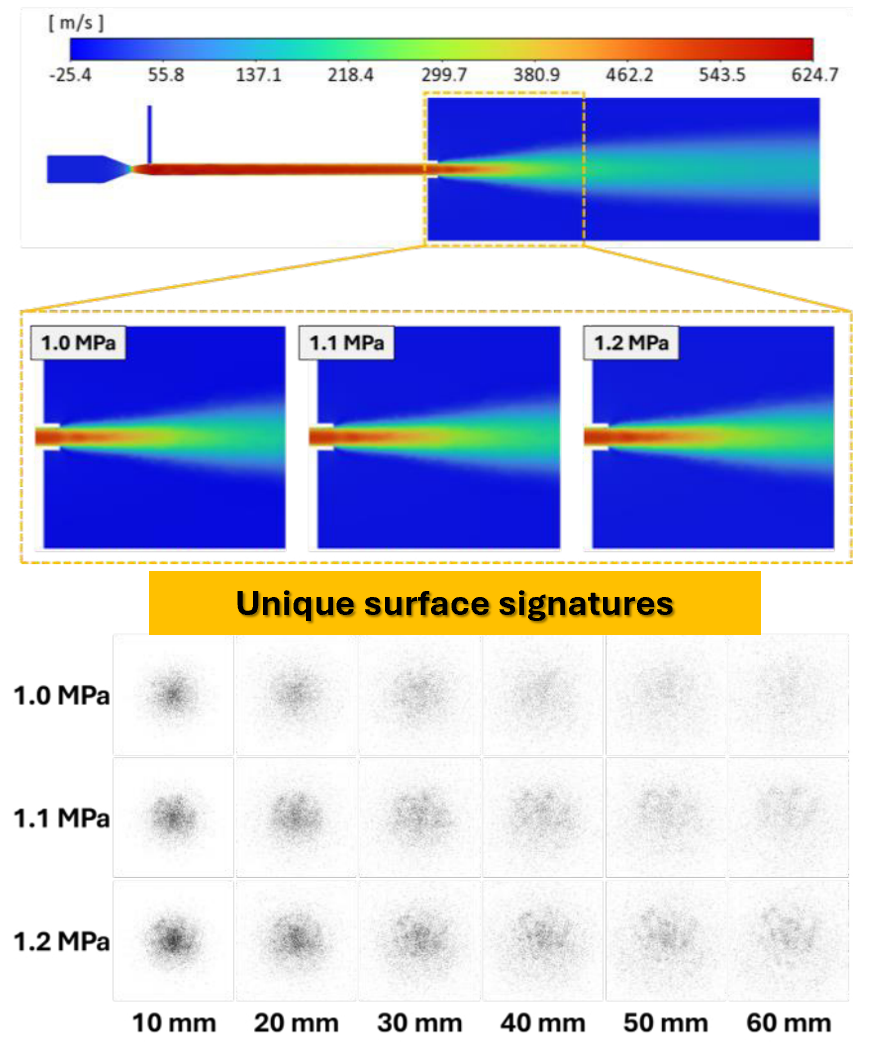 Pulsed cold spray system for physical unclonable function generationChangheon Han, Ted Gabor, Hojun Lee, and 3 more authorsProcedia CIRP, Nov 2025
Physical Unclonable Functions (PUFs) have gained remarkable attention as a promising anti-counterfeiting solution by generating unique physical fingerprints or trust anchors derived from inherent manufacturing randomness and authenticated verification processes. Pulsed Cold Spray (PCS)—an emerging advanced manufacturing process—leverages cyclic compressed turbulent gas pulses to propel particles with high kinetic energy, enabling the creation of arbitrary patterns at each pulse that are inherently unique and physically unclonable. This study investigates the potential of PCS for generating PUFs. The gas and particle dynamics within the PCS system was analysed, and the geometry of particles at specific distances from the nozzle was visualized based on simulation results. Key parameters for achieving an optimal PUF were identified, and the simulation outcomes were validated through comparison with experimental data, confirming the conditions necessary for optimal PUF generation.
-
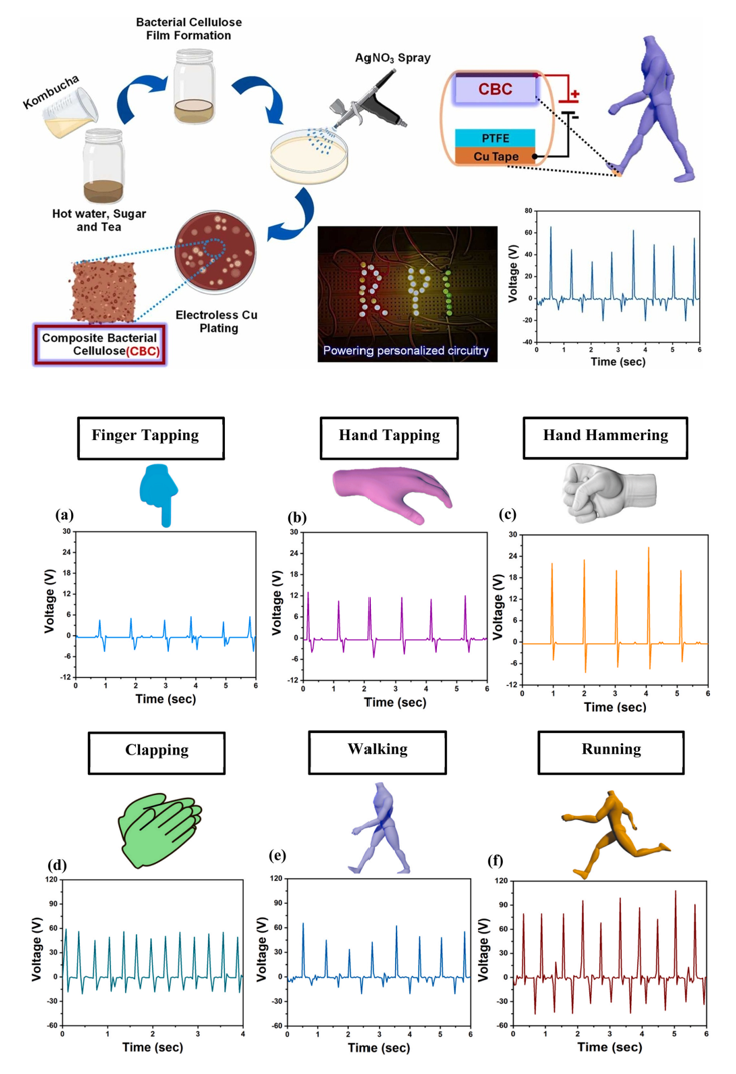 A composite bacterial cellulose for enhanced-performance triboelectric and piezoelectric nanogeneratorsSk Shamim Hasan Abir, Charli Smith, Jared Zornitzer, and 2 more authorsNano Energy, Nov 2025
Integrating sustainable materials into energy devices, such as triboelectric nanogenerators (TENGs) and piezoelectric nanogenerators (PENGs), offers a promising path towards renewable and eco-friendly energy solutions. Among various sustainable materials, “bacterial cellulose” (BC) stands out for its biocompatibility, affordability, mechanical strength, high surface area and porosity. However, its application in nanoenergy devices is hindered by the challenge of seamlessly embedding an electrically conductive layer (electrode) within BC while preserving its intrinsic properties. This study addresses this hurdle by developing a composite bacterial cellulose (CBC) structure through an innovative manufacturing pathway comprising: (i) spray coating; (ii) electroless copper (Cu) plating; and (iii) freeze drying. The electroless plating step creates a conformal, strongly bonded Cu layer (electrode) on the spray coated surface (i.e., silver nitrate), producing the CBC (i.e., BC with an integrated Cu sublayer). The subsequent freeze-drying step removes moisture from the CBC, while maintaining the mechanical integrity and flexibility. The fabricated CBCs are thoroughly characterized in terms of film thickness, electrical resistance, microstructure, mechanical properties, breathability, and biodegradability. TENG and PENG devices incorporating CBC as the functional tribolayer exhibited 2.1- fold and 4.8-fold improvements in energy harvesting, respectively, compared to control devices. Notably, the TENG with CBC achieved a peak open-circuit voltage of 128 V and a power density of 443.5 μW/cm², while the PENG with CBC recorded 27.2 V and 13.26 μW/cm² with a promising pressure sensitivity of 0.423 V/N. Besides, both devices maintained stable energy harvesting performance over 5000 operational cycles, underscoring their durability and reliability. This work presents a novel CBC structure along with an innovative manufacturing strategy that can pave the way for next generation nanoenergy devices for mechanical energy harvesting, biomotion sensing, and self-powered sensing applications.
-
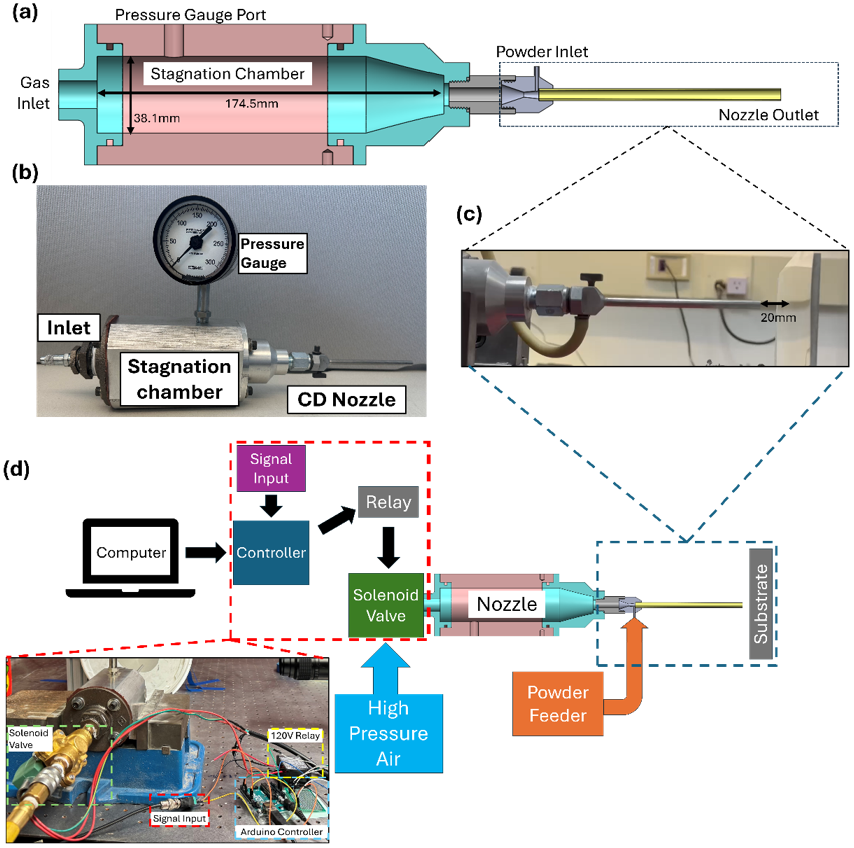 Design, modeling, and characterization of a pulsed cold spray systemTed Gabor, Yijie Wang, Semih Akin, and 4 more authorsSurface and Coatings Technology, Nov 2025
Pulsed cold spray (PCS) is a type of cold spray metal coating technique that incorporates cyclical compressed gas pulses to control the gas-powder for improved surface deposition. In recent years, PCS has garnered great attention owing to its unique pulsed nature in the domains of dense coatings, metal matrix composite coatings, cellular metallic structures, etc. However, research on the PCS to uncover process-structure-property relationships of this emerging deposition technique is limited. To this end, this study thoroughly investigates PCS to gain a deeper understanding of this coating technique. First, a PCS system incorporating a converging-diverging (CD) nozzle is designed and prototyped. Next, two-phase flow (i.e., gas + powder) within the PCS is modeled using computational fluid dynamics (CFD). The modeling results are then experimentally validated using particle image velocimetry (PIV), followed by a case study on surface deposition. The results show that the optimal powder injection window occurs when the gas inlet pressure is at least 99 % of the set inlet pressure, achieving a steady-state gas flow for 100 ms. CFD modeling showed that Mach diamonds formed at the nozzle exit by 30 ms, though powder velocity does not reach steady-state until 50 ms. Numerical modeling captured the average particle with an error of ≈8 % as compared to the PIV measurements. Furthermore, surface deposition experiments showed that the PCS can create dense coatings with remarkably less porosity (i.e., 1.73-fold) as compared to the traditional CS. Overall, this study unravels the intricacies of designing and modeling of a PCS system with a CD nozzle, complemented by surface deposition experiments.
-
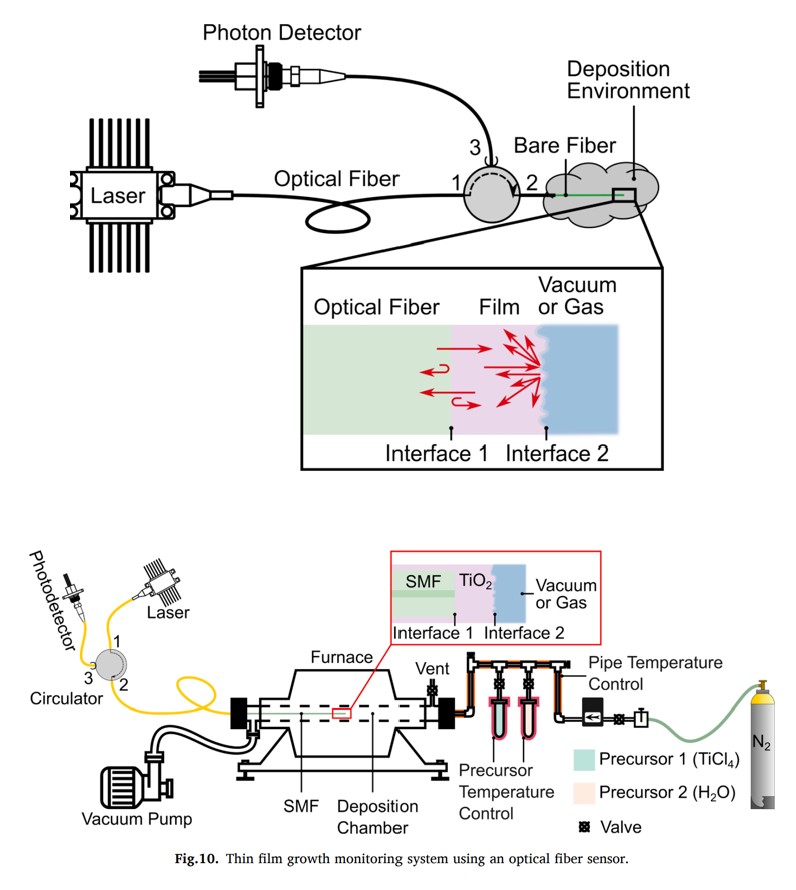 Real-time monitoring of thin film thickness and surface roughness using a single mode optical fiberFengfeng Zhou, Siying Chen, Semih Akin, and 2 more authorsMechanical Systems and Signal Processing, Nov 2025
This research introduces an innovative method for real-time monitoring thin film growth and surface roughness using a single mode optical fiber without any additional treatment. The cleaved end of the fiber was installed within the deposition chamber, allowing the thin film to be deposited directly onto the fiber tip. During the deposition process, a Fabry-Pérot interferometer was formed with its cavity length equal to the film thickness. As the thin film grows, it alters the cavity length, resulting in a measurable interferogram. In cases where the film surface is not optically smooth, surface roughness becomes a function of deposition time. By leveraging this phenomenon, this research demonstrates a method for calculating film thickness and surface roughness using Hilbert Transform along with an iterative method. It was found that the measured film thickness fluctuates around the ground truth given by a simulation, with an error on the nanometer scale (≤4 nm) and the reflectivity error is less than 0.004 (maximum error percentage of 5.86 %). Compared to traditional quartz crystal microbalance counterpart, the proposed method directly measures the film thickness rather than mass of the thin film. Furthermore, the compact probe design allows it to be placed closer to the substrate, enhancing monitoring precision. This method offers a simple, quick, and affordable approach to monitor film thickness and surface roughness, effectively addressing the current challenges in the field.


2024
-
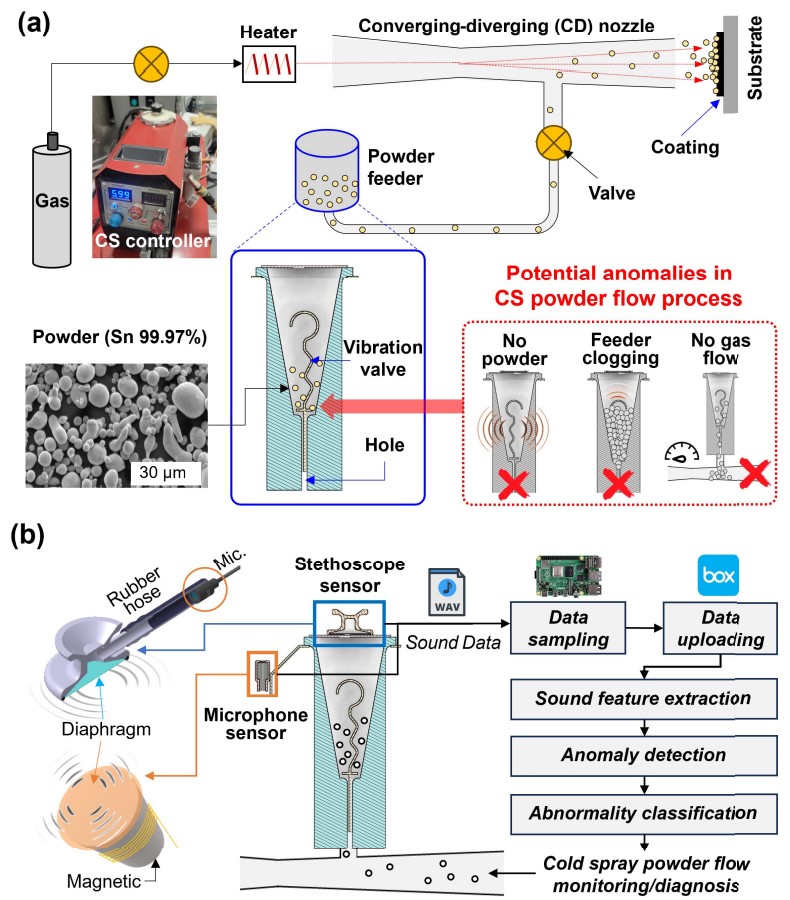 A stethoscope-guided interpretable deep learning framework for powder flow diagnosis in cold spray additive manufacturingJiho Lee, Semih Akin, Yuseop Sim, and 5 more authorsManufacturing Letters, Nov 2024
Cold spray (CS) particle deposition, also known as cold spray additive manufacturing, has garnered great attention as an advanced additive manufacturing (AM) and surface deposition technology, facilitating rapid and scalable production of functional parts and surfaces in a solid-state manner. In CS, consistent and precise feeding of functional feedstock powders is crucial for achieving effective particle deposition. However, vibratory-based powder feeders often face challenges associated with powder delivery and powder segregation. This underscores the critical need for a precise diagnostic framework to effectively control powder flow during cold spraying. To this end, the present study proposes a powder flow monitoring framework for the CS process using a stethoscope sound-guided interpretable deep learning (IDL) model. Internal sound data from the vibrated powder feeder is collected through a stethoscope sensor to train a two-stage model. In the first stage, a convolutional autoencoder (CAE) is trained to build an unsupervised learning-based anomaly detector, which identifies classification thresholds based on the receiver operation characteristic curve. In the second stage, a convolutional neural network (CNN) model is trained as the powder flow diagnostic tool by considering process anomalies, namely (i) no powder flow; (ii) feeder clogging; and (iii) no gas flow. The results reveal that the stethoscope sound-guided model achieves a classification accuracy of 95% on the test set, significantly outperforming benchmark utilizing typical external-sound recording microphones in diagnosing CS powder flow. Furthermore, the model is visualized and interpreted by employing t-distribution stochastic neighbor embedding and integrated gradients techniques to enhance reliability of CS powder flow diagnosis. This research highlights the effectiveness of the stethoscope sound-guided IDL model for in situ powder flow monitoring and process diagnosis in the domain of cold spray additive manufacturing, contributing to effective particle deposition.
-
 One-step fabrication of functionalized electrodes on 3D-printed polymers for triboelectric nanogeneratorsSemih Akin, Taehoo Chang, Sk Shamim Hasan Abir, and 8 more authorsNano Energy, Nov 2024
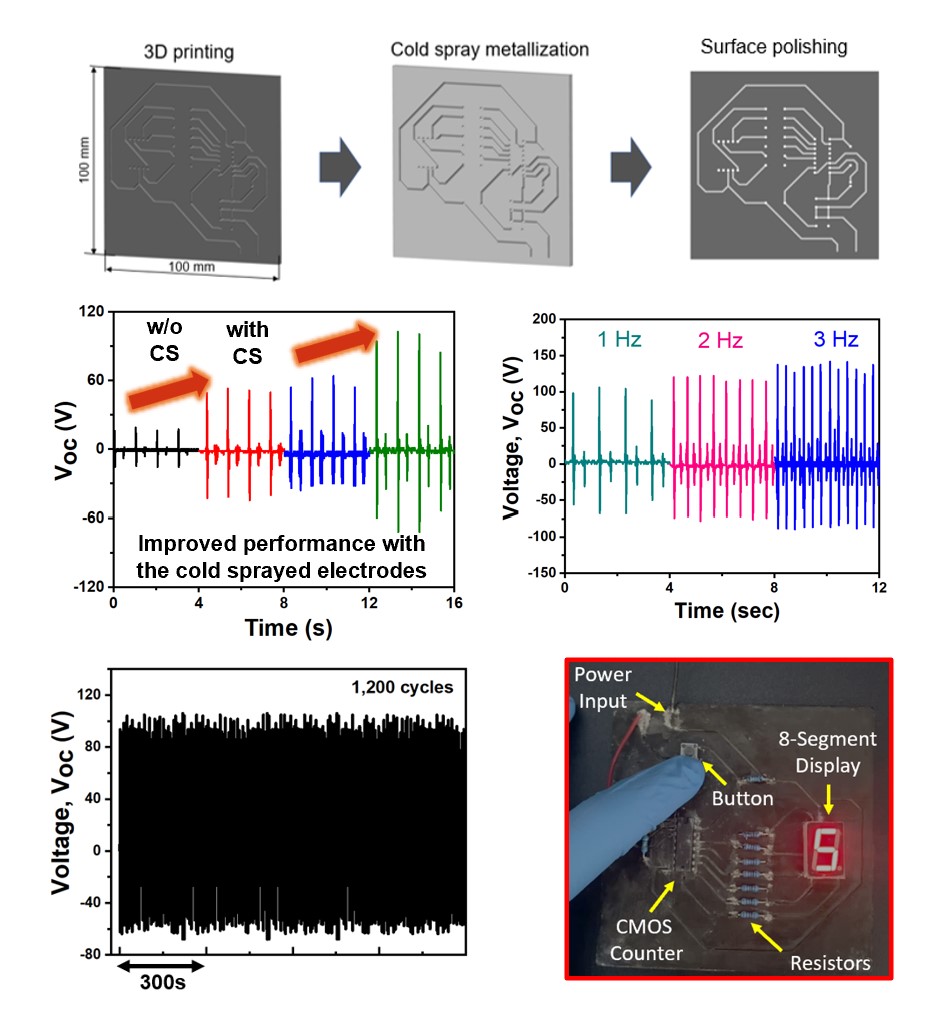
Triboelectric nanogenerators (TENGs) have gained remarkable attention in energy harvesting and smart sensing, allowing for converting mechanical energy into electrical energy. Despite great potential and progress made in this field, there remains a high demand for high-performance electrodes that are produced with sustainable, low-cost, lightweight, and durable materials such as polymers. Here, by combining the material extrusion 3D printing and the cold spray particle deposition methods, we employ a complete additive manufacturing (AM) approach to fabricate functionalized electrodes on 3D-printed parts for TENG technology. First, polylactic acid (PLA) parts were produced by material extrusion printing. Next, the cold spray process (CS) was utilized as just a one-step fabrication method of the conductive electrodes on the printed parts, eliminating the need for surface activation, over-plating, curing, and/or post-processing. Additionally, the process-structure-property relationships of the CS process were uncovered to fabricate high-performance electrodes for TENGs. The resulting electrodes demonstrate promising electrical conductivity (9.8 × 10⁴ S.m−1), adhesive strength, stability, and micro-roughness (Ra = 6.32 µm). The TENG with the fabricated electrode generates an open-circuit voltage of 174 V, which is nearly 1.85–2.9-fold higher than that of the control TENGs. It achieves the short-circuit density of ≈ 55 mA/m2, and the power density of 1676 mW/m². Besides, to address the low-spatial resolution of the cold spray metallization, a manufacturing pathway is proposed, aiming to achieve higher line resolution (1 mm linewidth) electrodes for polymer electronics. This work provides a manufacturing strategy that can advance the field of TENG and polymer electronics by addressing the limitations of conventional electrode manufacturing techniques.
-
 Highly flexible, conductive, and antibacterial surfaces toward multifunctional flexible electronicsDuygu Gazioglu Ruzgar, Semih Akin, Seungjun Lee, and 6 more authorsInternational Journal of Precision Engineering and Manufacturing-Green Technology, Nov 2024
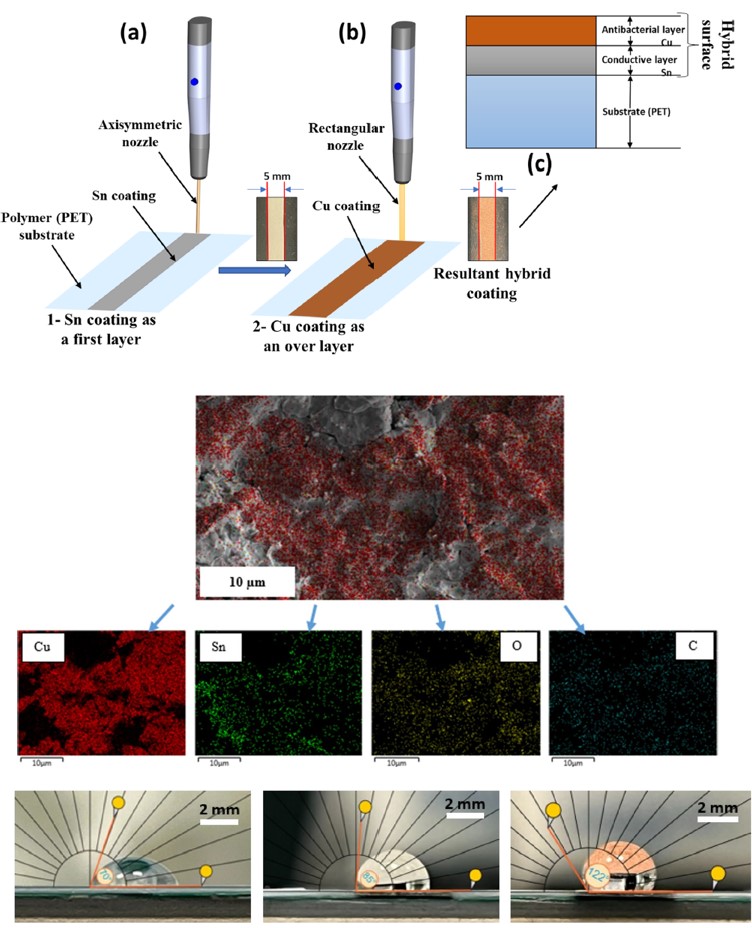
Conductive metallization of polymer surfaces, owing to the integration of unique features of dissimilar materials (i.e., polymer + metal), is becoming the central focus in flexible polymer electronics. However, fabrication of multifunctional surfaces on polymers in a high-throughput and robust manner at ambient conditions remains challenging. In this study, we employ the cold spray (CS) particle deposition technique to produce multifunctional hybrid surfaces on a flexible polymeric substrate (PET) toward flexible electronics. In this regard, soft metal particles (Sn), are deposited on the polymer surface as an “interlayer” followed by the over-coating of hard metal (Cu) film to create hybrid (Sn + Cu) surfaces. Studies on microstructure, adhesion strength, and water contact angle are conducted to characterize the resulting surface structure. By leveraging the optimum CS settings, multifunctional surfaces with promising electrical conductivity (5.96 × 10⁵ S.m−1), flexibility, adhesive strength, and hydrophobicity (contact angle $≈$122°) were achieved. Moreover, the antibacterial performance of the surface is confirmed by the in vitro antibacterial tests in a manner that > 99% of the bacteria were inhibited. This work provides a promising strategy for high-throughput manufacturing of multifunctional surfaces (flexible + conductive + antibacterial surfaces) toward multifunctional flexible electronics.
-
 A predictive modeling approach for cold spray metallization on polymersJung-Ting Tsai, Semih Akin, David F Bahr, and 1 more authorSurface and Coatings Technology, Nov 2024
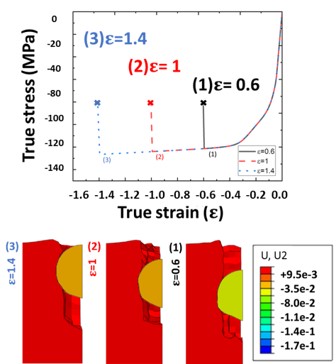
Cold spray (CS) particle deposition, also known as cold spray additive manufacturing, presents opportunities for high-throughput functional metallization on polymeric substrates. However, modeling CS-based polymer metallization and quantifying deposition probability face challenges due to the need for dedicated and cost-intensive experimental characterization tools. This underscores a critical need for predictive approaches such as numerical modeling. Toward this end, the present work aims to address this critical gap through numerical modeling by utilizing the three-network polymer model (TNM) in a manner that deposition probability can be predicted under the given CS process settings. In this regard, CS of both hard and soft particles with varying densities and diameters was modeled, followed by experimental validation. Notably, a dimensional number (η) – representing the fraction of the particle kinetic energy - was derived as a predictive tool to estimate the CS metallization probability on polymeric substrates. Furthermore, the modeling endeavor was extended to develop a correlation between the η number and the percent area coverage of the CS process. It was found that η value should be higher than 0.8 for effective CS polymer metallization. Controlled experiments confirmed the viability and reliability of the numerical modeling as a high-fidelity predictive methodology for the CS metallization on polymers, thereby minimizing the need for cost-intensive trial-and-error efforts.
-
 Fully additively manufactured counter electrodes for dye-sensitized solar cellsSemih Akin, Sungdo Kim, Chul Ki Song, and 2 more authorsMicromachines, Nov 2024
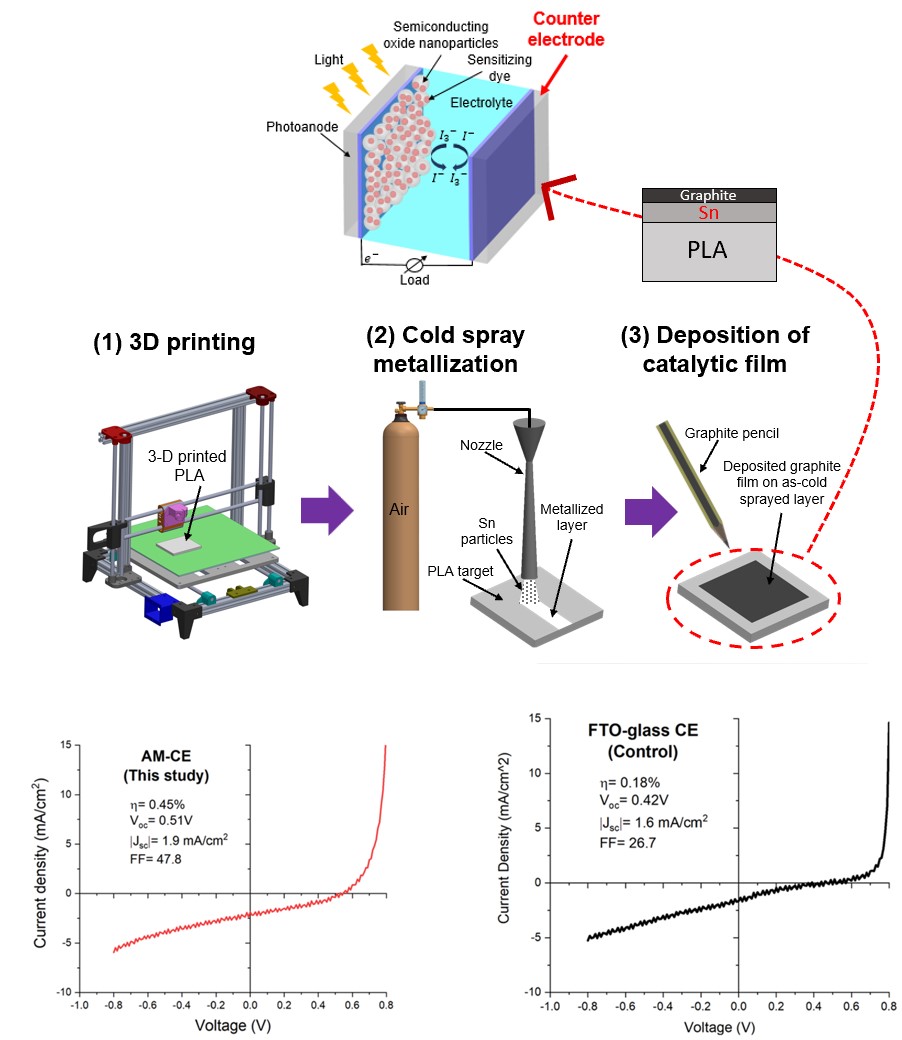
In dye-sensitized solar cells (DSSCs), the counter electrode (CE) plays a crucial role as an electron transfer agent and regenerator of the redox couple. Unlike conventional CEs that are generally made of glass-based substrates (e.g., FTO/glass), polymer substrates appear to be emerging candidates, owing to their intrinsic properties of lightweight, high durability, and low cost. Despite great promise, current manufacturing methods of CEs on polymeric substrates suffer from serious limitations, including low conductivity, scalability, process complexity, and the need for dedicated vacuum equipment. In the present study, we employ and evaluate a fully additive manufacturing route that can enable the fabrication of CEs for DSSCs in a high-throughput and eco-friendly manner with improved performance. The proposed approach sequentially comprises: (1) material extrusion 3-D printing of polymer substrate; (2) conductive surface metallization through cold spray particle deposition; and (3) over-coating of a thin-layer catalyzer with a graphite pencil. The fabricated electrodes are characterized in terms of microstructure, electrical conductivity, and photo-conversion efficiency. Owing to its promising electrical conductivity (8.5 × 10⁴ S·m−1) and micro-rough surface structure (Ra ≈ 6.32 µm), the DSSCs with the additively manufactured CEs led to ≈2.5-times-higher photo-conversion efficiency than that of traditional CEs made of FTO/glass. The results of the study suggest that the proposed additive manufacturing approach can advance the field of DSSCs by addressing the limitations of conventional CE manufacturing platforms.
-
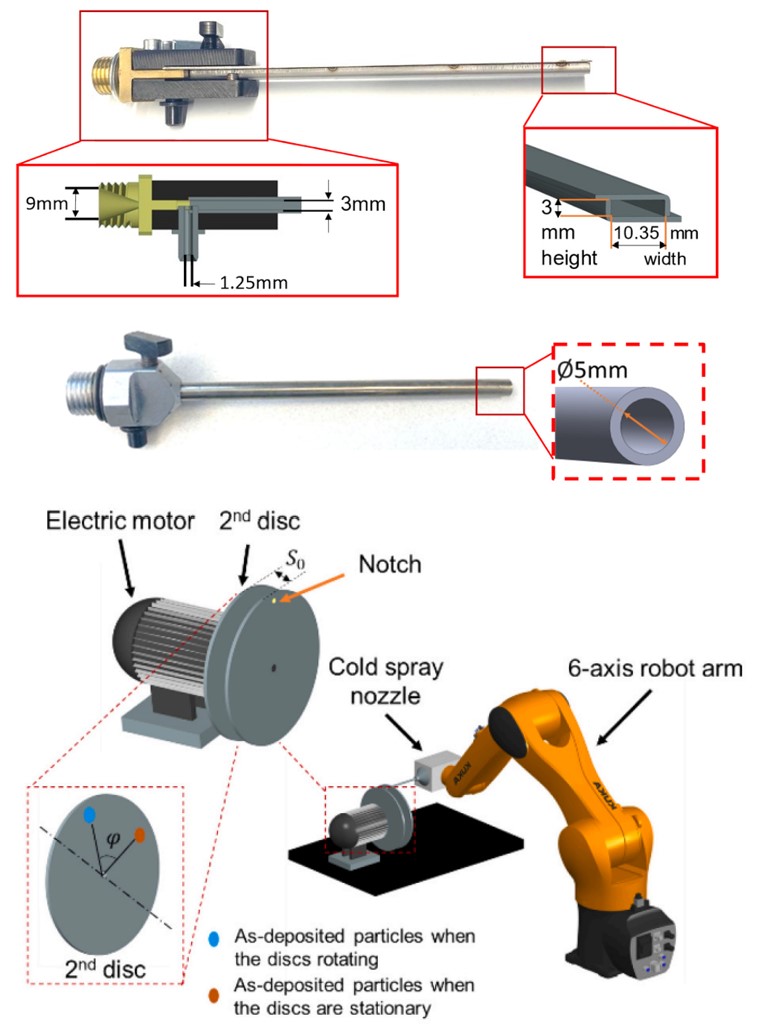 Numerical studies on cold spray gas dynamics and powder flow in circular and rectangular nozzlesTheodore Gabor, Semih Akin, and Martin Byung-Guk JunJournal of Manufacturing Processes, Nov 2024
Cold Spray (CS) is an emerging metal additive manufacturing and surface coating technology, where metallic microscale powders are accelerated to supersonic velocities followed by impact onto a target substrate. In CS, the design of the cold spray nozzle is the pillar, determining the efficacy and quality of the deposited layers as it both affects the gas dynamics and powder flow. However, comparative studies on the gas-powder flow dynamics within different nozzle profiles are limited. In this paper, two prominent CS nozzle exit profiles – circular and rectangular – are extensively studied using numerical modeling by considering both soft and hard feedstock powders (i.e., tin (Sn) and copper (Cu)). In this regard, computational fluid dynamics (CFD) simulations are performed to investigate the effect of inlet gas pressure and temperature on supersonic jet formation and powder dispersion characteristics. In regard to the gas flow, the rectangular nozzle showed flow separation much earlier in the nozzle compared to the circular nozzle under the same process settings. Notably, this phenomenon was found to be more drastic at lower gas pressures. As for the powder flow, it was observed that the rectangular nozzle is less effective at accelerating powders compared to the circular nozzle but allows for powders to reach higher temperatures. Moreover, particle deposition experiments on a composite substrate (GFRP) revealed that while the rectangular nozzle produced more uniform particle deposition (Ra = 8.12), it led to a thinner metal coating (≈53 %) with significantly higher electrical resistance (143-fold) compared to the circular nozzle. The results provide valuable insights into understanding the advantages and limitations of both the circular and rectangular nozzle profiles in CS, contributing to more efficient and high-quality particle deposition.


2023
-
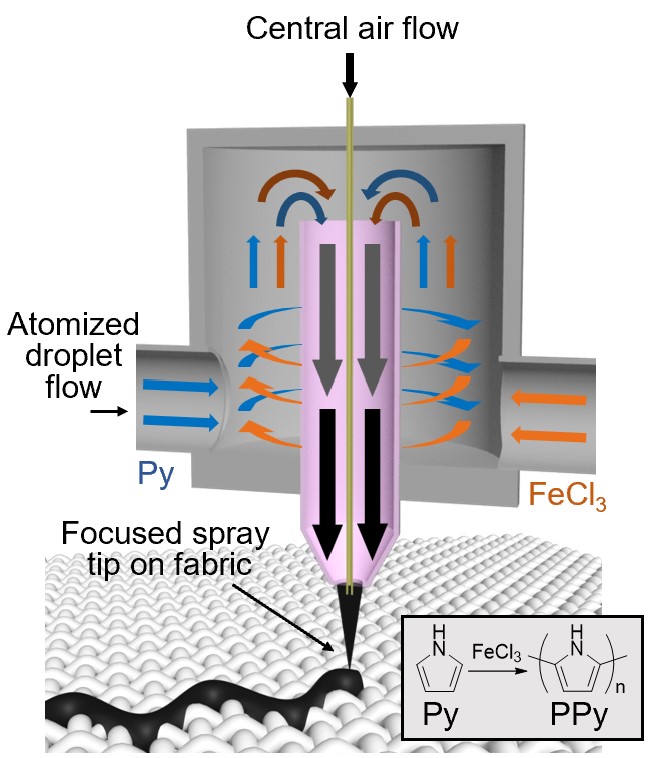 In situ spray polymerization of conductive polymers for personalized e-textilesTaehoo Chang†, Semih Akin†, Seungse Cho†, and 8 more authorsACS nano, Nov 2023
E-textiles, also known as electronic textiles, seamlessly merge wearable technology with fabrics, offering comfort and unobtrusiveness and establishing a crucial role in health monitoring systems. In this field, the integration of custom sensor designs with conductive polymers into various fabric types, especially in large areas, has presented significant challenges. Here, we present an innovative additive patterning method that utilizes a dual-regime spray system, eliminating the need for masks and allowing for the programmable inscription of sensor arrays onto consumer textiles. Unlike traditional spray techniques, this approach enables in situ, on-the-fly polymerization of conductive polymers, enabling intricate designs with submillimeter resolution across fabric areas spanning several meters. Moreover, it addresses the nozzle clogging issues commonly encountered in such applications. The resulting e-textiles preserve essential fabric characteristics such as breathability, wearability, and washability while delivering exceptional sensing performance. A comprehensive investigation, combining experimental, computational, and theoretical approaches, was conducted to examine the critical factors influencing the operation of the dual-regime spraying system and its role in e-textile fabrication. These findings provide a flexible solution for producing e-textiles on consumer fabric items and hold significant implications for a diverse range of wearable sensing applications.
-
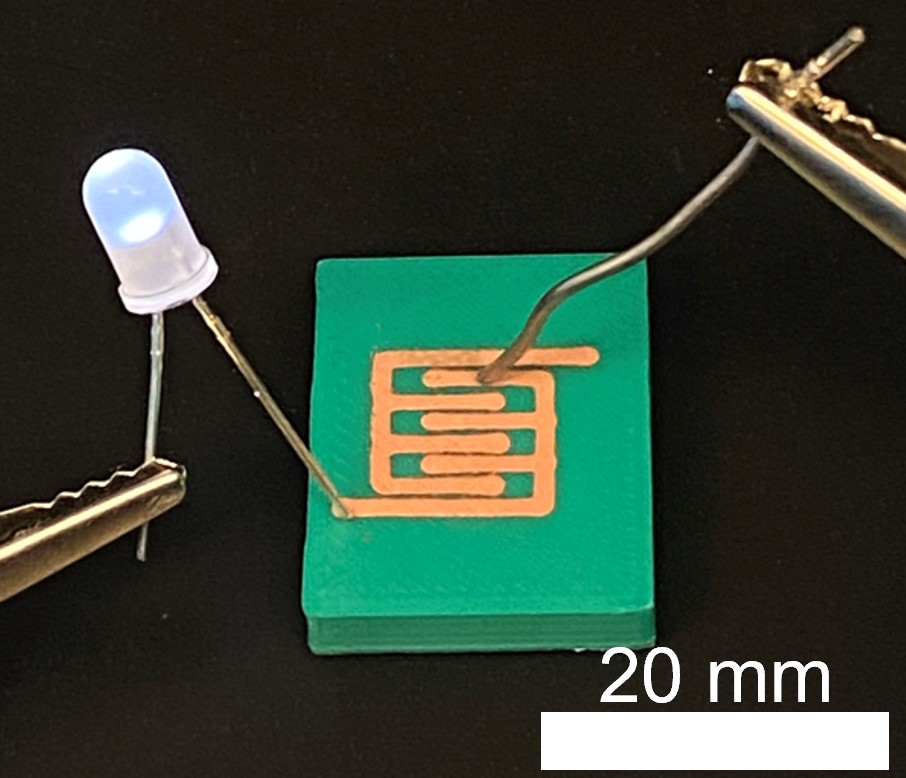 Selective surface metallization of 3D-printed polymers by cold-spray-assisted electroless depositionSemih Akin, Chandra Nath, and Martin Byung-Guk JunACS Applied Electronic Materials, Nov 2023
Selective surface metallization of insulating polymers is of particular interest in smart films, energy harvesting, and sensing applications. However, traditional polymer metallization techniques face challenges due to the need for environmentally hazardous pretreatment (e.g., strong acid etching) and cost-intensive palladium seeding processes, thereby limiting the large-scale deployment of metallized polymers. With the advent of rapid prototyping, metallization on additively manufactured polymers drew attention in a variety of technological applications, as it enables the fabrication of low-cost electronic devices. In the current work, we deploy and evaluate a hybrid additive metallization route that can enable the fabrication of functional selective metallization on 3D-printed polymers in a rapid and eco-friendly methodology with improved electrical conductivity. The metallization route sequentially comprises (1) material extrusion 3D printing, (2) cold spray metallization, and (3) electroless deposition. The resulting metal (copper) layers on the polymer surfaces are characterized in terms of the microstructure, surface chemistry, wettability, and electrical conductivity. Notably, selective metallization with promising electrical conductivity (i.e., 6.47 × 10⁶ S m–1 for ABS and 5.27 × 10⁶ S m–1 for PLA parts) is achieved on both linear and curvilinear polymer surfaces. Moreover, strong adhesion between the metallized layer and the 3D-printed structures was confirmed by adhesion tests. Detailed evaluation of the proposed hybrid metallization route unlocks great potential to advance the field of conductive surface metallization on 3D-printed polymers.
-
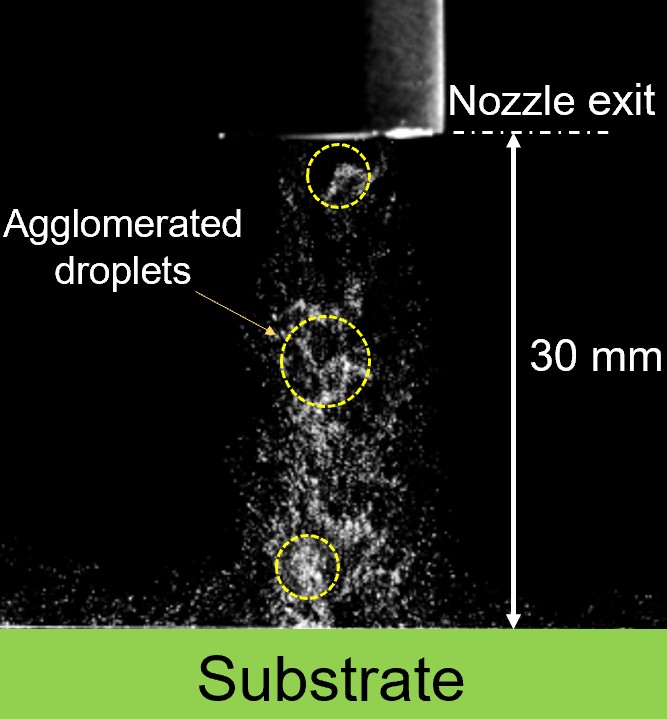 A study on converging-diverging nozzle design for supersonic spraying of liquid droplets toward nanocoating applicationsSemih Akin, Puyuan Wu, Chandra Nath, and 2 more authorsJournal of Manufacturing Science and Engineering, Nov 2023
Supersonic cold spray (CS) of functional nanomaterials from atomized droplets has attracted significant attention in advanced thin-film coating as it enables particle deposition with high-adhesion strength. In CS, optimum design of the supersonic nozzle (i.e., converging-diverging nozzle) is essential for accelerating particles to desired velocities. However, research on the nozzle design for supersonically spraying of “liquid droplets” for nanocoating applications is limited. To this end, we investigate the effect of nozzle geometrical parameters, including throat diameter, exit diameter, and divergent length on droplets impact velocity by numerical modeling and experimental validation, followed by a case study on nanocoating. The discrete-phase modeling was employed to study droplets’ flow behavior in continuous gas flow for various nozzle geometries. The results reveal that the nozzle expansion ratio, defined as a function of throat and exit diameters, has a significant influence on droplet velocity, followed by divergent length. Noteworthy, to correctly accelerate “low-inertia liquid microdroplets,” it was found that the optimum nozzle expansion ratio for axisymmetric convergent-divergent nozzles should be in a range of 1.5–2.5, which is different and way smaller than the recommended expansion ratio (i.e., 5–9) for CS of conventional micron-scale “metal” powders. Based on the simulation results, an optimum design of supersonic nozzle is established and prototyped for the experimental studies. Particle image velocimetry (PIV) was used to experimentally investigate the spray flow field and to validate the numerical modeling results. Moreover, coating experiments using the optimized nozzle confirmed the effective supersonic spraying of droplets containing nanoparticles, thereby showing the potential for advanced nanocoating applications.
-
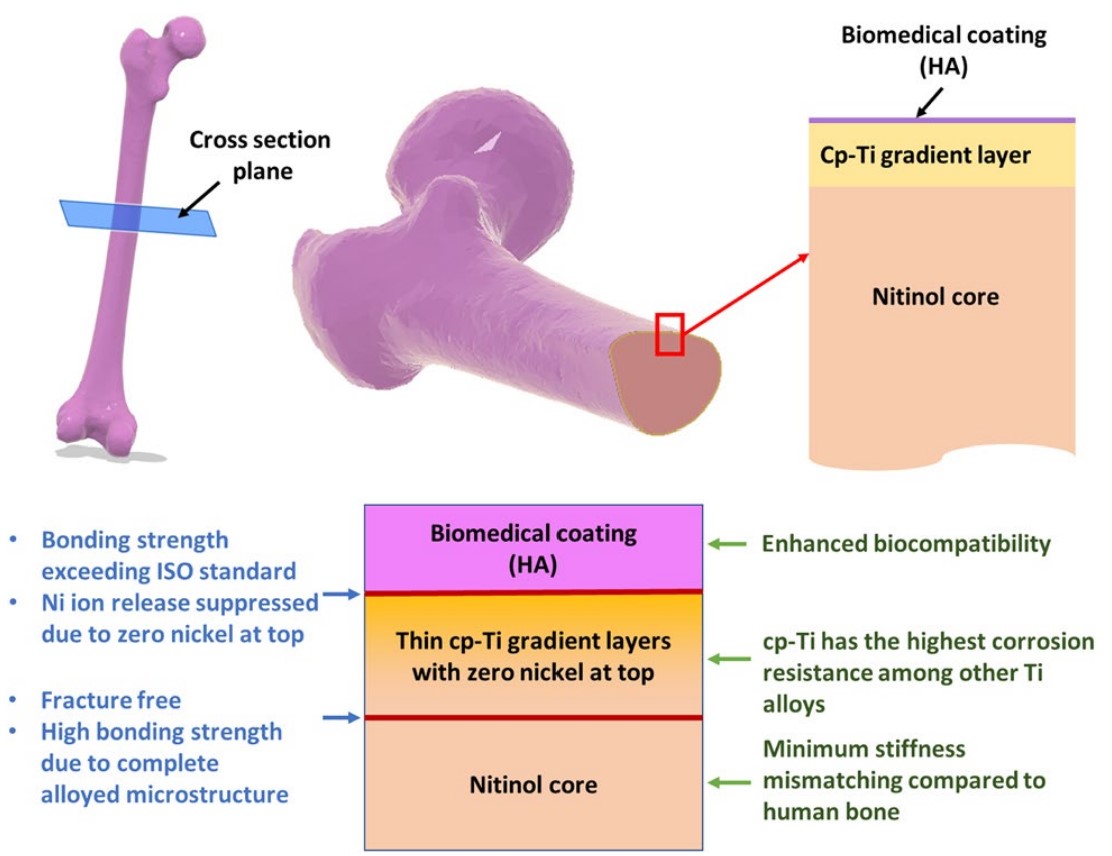 A Nitinol structure with functionally gradient pure titanium layers and hydroxyapatite over-coating for orthopedic implant applicationsJ Lee, Semih Akin, JR Walsh, and 3 more authorsProgress in Additive Manufacturing, Nov 2023
In this study, functionally gradient multi-layer coatings are developed on the Nitinol surface for orthopedic implant applications to eliminate potentially toxic Ni ion release and to improve biocompatibility. Using the direct energy deposition (DED) technique, both the core Nitinol and titanium gradient layers are additively manufactured with high purity. The completely alloyed microstructure without microstructural defects provides superior bonding strength compared to other metal coating techniques that rely on particle-to-particle bonding (e.g., thermal spray and physical/chemical vapor deposition). An additional biomedical over-coating of hydroxyapatite (HA) was deposited on the outer surface of the gradient layer structure using the cold spray technique to enhance biocompatibility without compromising high crystallinity. The resultant bonding strength of HA coating was determined to be 26 MPa, which exceeded the minimum adhesion strength requirement (15 MPa) by the ISO-13779 standard (implants for surgery-HA). The in vitro test on the nickel (Ni) ion release revealed that the Ni release rate from the entire gradient Nitinol structure is very low (0.036 μg/$\mathrmcm^2$), which is an order of magnitude smaller than commercial Nitinol orthodontic wires, thereby suggesting a promising potential of the novel Nitinol structure in orthopedic and other implantable applications.
-
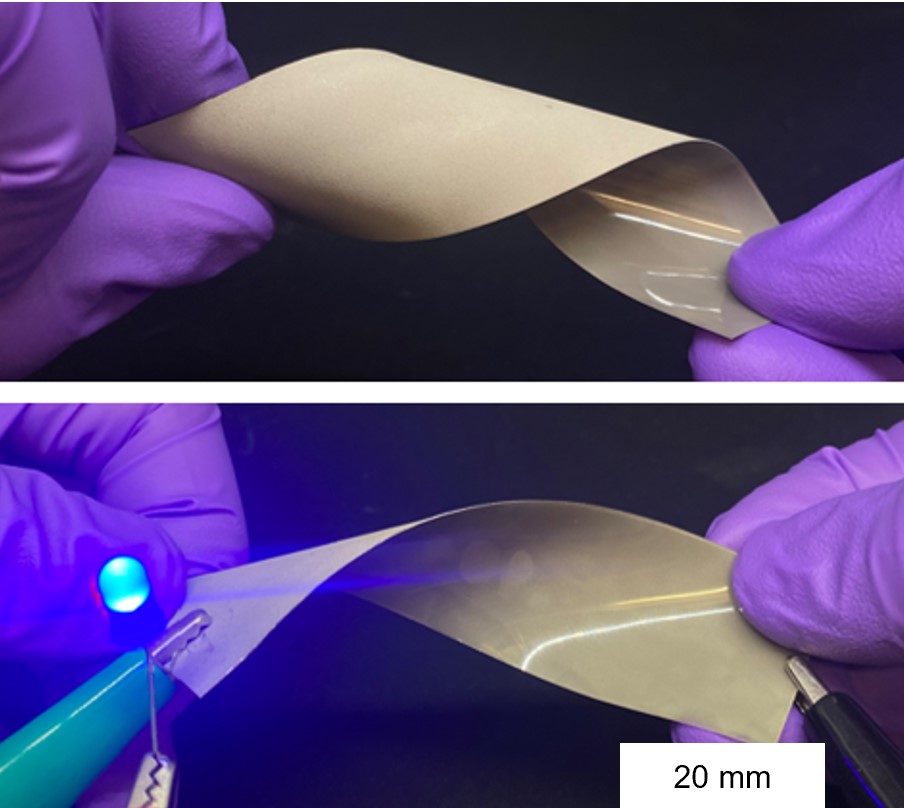 Cold spray direct writing of flexible electrodes for enhanced performance triboelectric nanogeneratorsSemih Akin, Young Won Kim, Shujia Xu, and 3 more authorsJournal of Manufacturing Processes, Nov 2023
Triboelectric nanogenerator (TENG) is an emerging energy harvesting device to effectively harness various mechanical energy sources. In TENG technology, polymers are of particular interest as tribo-negative materials owing to their unique properties (e.g., charge storage capability, impact resistance, flexibility, low cost, recyclability, etc.). Despite significant advances, one major challenge for TENG is to develop high-performance back electrodes that are conformably attached to the tribo-negative polymer substrates to fully exploit the potential of TENG in energy harvesting. To this end, the present study is aimed to employing direct “cold spray” particle deposition as just one-step fabrication method for high-performance electrodes on flexible polymers. In this regard, Tin (Sn) particles are directly written on the polymer (PET) surface by cold spraying to achieve conformal electrodes with high-adhesive strength and stable electrical conductivity. The resulting electrodes are thoroughly characterized in terms of microstructure, adhesion strength, and electrical performance. Arc-shaped TENG devices with both traditional aluminum (control) and cold-sprayed Sn electrodes are fabricated, followed by evaluating the TENGs’ performance. Owing to the strong adhesion and micro-roughness (i.e., Ra = 4.865 μm) of the Sn electrodes, electricity generation performance was found to be improved by ≈2.4 folds as compared to the control TENG. The TENG with Sn electrode can generate an open-circuit output voltage of up to 243 V with a maximum output power of 130 mW/m2, thereby indicating the promising potential of the cold spray technique in TENG technology.
-
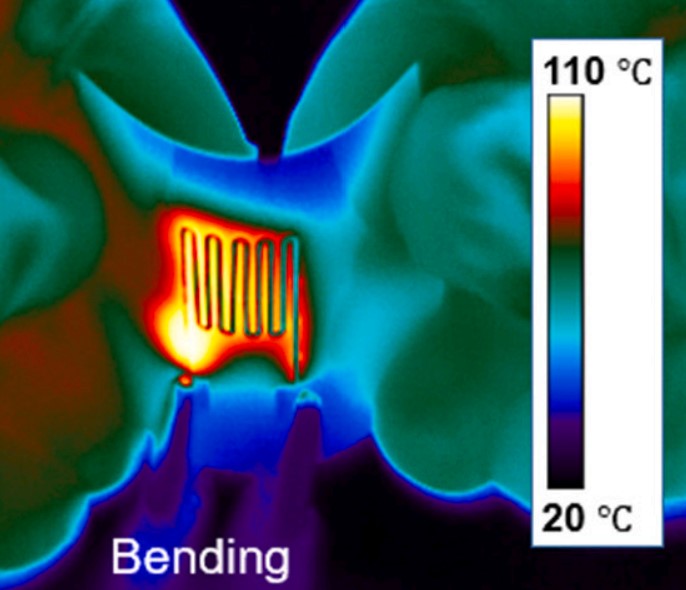 A cold spray-based novel manufacturing route for flexible electronicsSemih Akin, Seunghwan Jo, and Martin Byung-Guk JunJournal of Manufacturing Processes, Nov 2023
In this research, we propose a cold spray-based novel manufacturing route that enables the custom production of flexible electronics (FE) at high spatial resolution without a need of high-temperature post-sintering process. The proposed manufacturing route sequentially comprises: (1) cold spray metallization; (2) femtosecond laser machining; and (3) ultrasonic plastic welding. First, the flexible polymer (i.e., PET) surface is metallized by cold spray direct writing of Tin (Sn) particles under vacuum-and mask-free conditions. The as-metallized polymer film is then precisely cut into arbitrarily designed high-resolution electrodes (i.e., 500 μm linewidth) by femtosecond laser machining. Lastly, the laser-cut electrodes are joined onto a base polymer substrate via ultrasonic plastic welding to constitute mechanically resilient and conformal FE. In this way, the proposed route enables exploiting the unique features of cold spray deposits in FE (e.g., strong adhesion, high conductivity, minimal thermal input). The resultant printings show excellent electrical conductivity (1.08 × 10⁶ S·m−1), flexibility (60 % elongation), and adhesion strength without significantly compromising intrinsic polymer and functional coating properties. Moreover, a serpentine-shaped flexible microheater (10 × 10 mm2) is also fabricated to demonstrate the viability of the introduced platform in flexible microelectronics. This work potentially provides a promising route toward the rapid, scalable, and cost-effective production of high-resolution and high-performance FE in a mechanically resilient and conformal manner.


2022
-
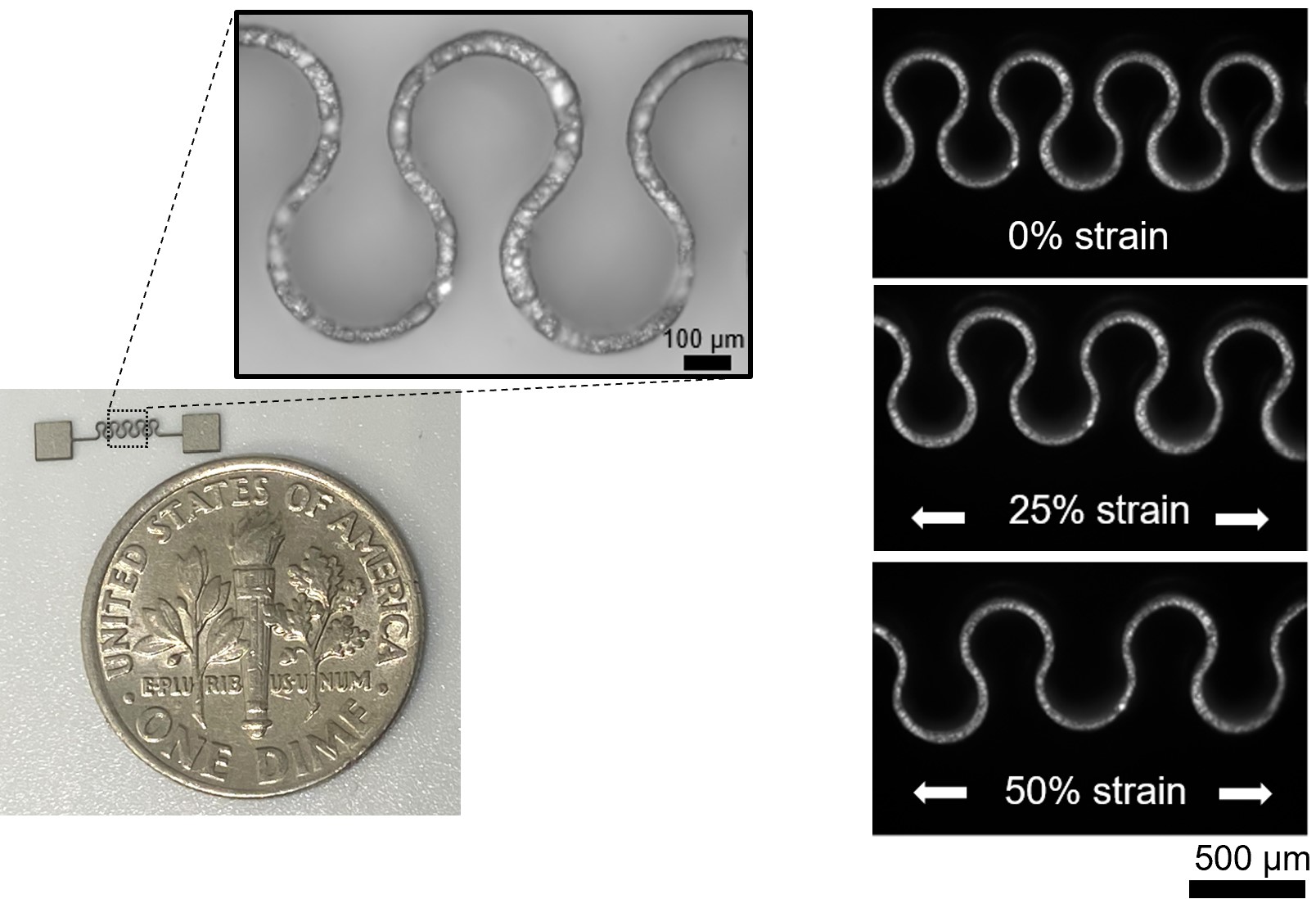 Cold spray-based rapid and scalable production of printed flexible electronicsSemih Akin, Seungjun Lee, Seunghwan Jo, and 4 more authorsAdditive Manufacturing, Nov 2022
Flexible electronics (FE) is attracting great attention from both scientific and industrial communities, and plays a crucial role in smart device applications. Despite great promise, traditional printing approaches (e.g., screen printing, ink-jet printing, etc.) often need a high-temperature post-sintering process to produce FE with desired electrical conductivity and adhesion strength. The post-sintering processes, however, often lead to fast oxidation of the functional coating while limiting the use of low-thermal budget substrates. Exponential advance of FE in a large-scale and energy-efficient manner relies on rationally eliminating the post-sintering processes. To this end, with the aim of uncovering process-structure-properties relationships, we employ the emerging cold spray (CS) technique for rapid and scalable production of FE without a need for high-temperature post-sintering. In this regard, micron-scale Tin (Sn) particles are directly written on a flexible polymer substrate (PET) by cold spraying under ambient conditions. The effect of CS process parameters on the resultant coatings is comprehensively characterized in terms of microstructure, film thickness, electrical conductivity, linewidth, and adhesion strength. The resulting electrodes show excellent electrical conductivity (6.98 × 10⁵ S m-1), adhesion strength, long-term stability, and flexibility without significant conductivity loss after 1000 bending cycles. By leveraging the CS operational settings, a resistive macro-heater (12 × 15 cm2) and an LED circuit (2.5 cm × 18 cm) are fabricated to demonstrate the applicability of the CS in printed FE. Moreover, to address the low-spatial resolution of CS writing, a case study on sequential CS and femtosecond laser machining is performed, which further led to ultra-high resolution (i.e., 30 µm linewidth) custom-designed flexible electrodes. Thus, the present study reveals the immense potential of the CS technique for rapid and scalable production of FE without the need for post-sintering.
-
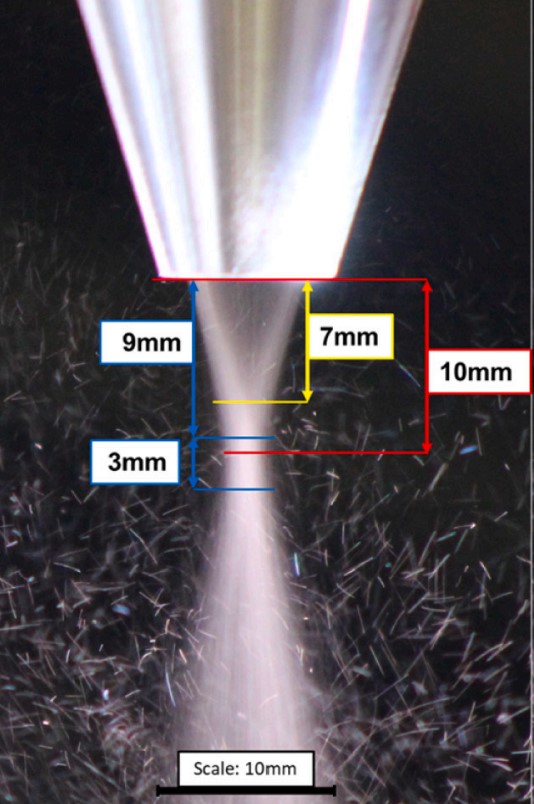 Continuous coaxial nozzle designs for improved powder focusing in direct laser metal depositionTheodore Gabor, Huitaek Yun, Semih Akin, and 3 more authorsJournal of Manufacturing Processes, Nov 2022
Direct Laser Metal Deposition (DLMD) is a type of Additive Manufacturing (AM) that deposits blown metallic powders from a nozzle onto a substrate. These powders are then simultaneously fused together by a high powered (0.1–1 kW, often ND:YAG) laser to form a deposited layer. Out of the various nozzle designs Continuous Coaxial nozzles provide the most even spray profile due to their annular profile. This is at the cost of a reduction in spray focusing. In this paper, the authors use full factorial analysis of simulated gas-powder nozzle flows to determine the impact of inlet pressure (1–10 kPa), powder inlet angle (0° – 25°), powder inlet offset (0–10 mm offset from the centerline), and internal groove shape (no grooves, straight grooves, tapered grooves) on nozzle focusing and powder velocity. It was determined that 1 mm wide straight grooves provided the best focusing, with powder concentrations reaching from 0.3 to 0.45 kg/m3 and particle cloud diameters reaching as low as 6 mm. CFD simulations showed that straight grooves drastically reduce tangential particle velocity components, forcing powders to point towards the nozzle’s focal point. A second batch of designs with a smaller nozzle angle (from 17° to 12°) focused on examining other groove geometries, including wider straight grooves and helical grooves. These simulations confirmed that narrow, straight grooves with uniform thickness provide improved powder focusing by controlling powder exit trajectories. In addition, helical grooves with steeper helical angles reduced the powder spray divergence. Finally, one control and the two best performing designs from each batch were manufactured and tested in a lab setting to experimentally observe the overall spray profile. Both the simulations and experiments showed an improvement in nozzle focusing with the addition of straight nozzle grooves, with experimental results showing a 17–18 % decrease in the spray width compared to the control nozzle.
-
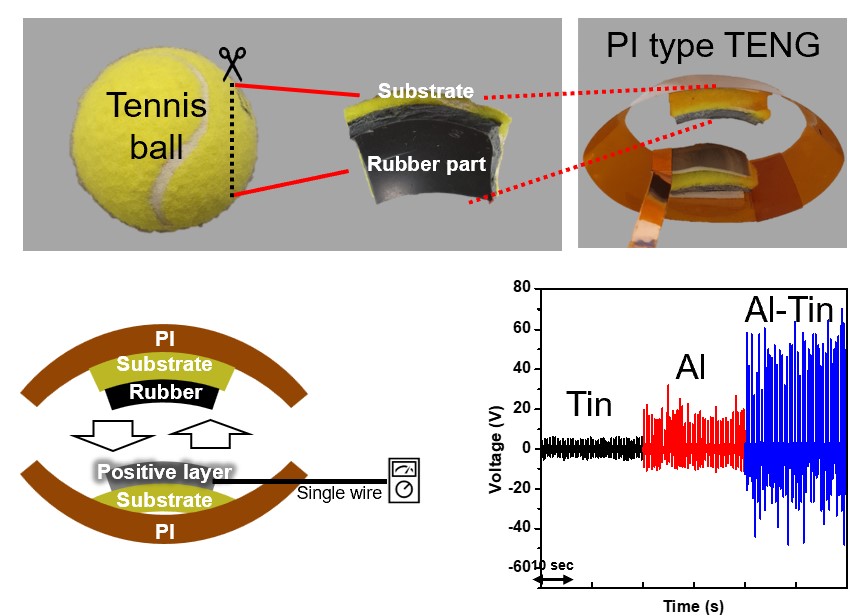 Enhanced performance of triboelectric nanogenerators and sensors via cold spray particle depositionYoung Won Kim, Semih Akin, Huitaek Yun, and 3 more authorsACS Applied Materials & Interfaces, Nov 2022
In this study, a high-performance triboelectric nanogenerator (TENG) is developed based on cold spray (CS) deposition of composite material layers. Composite layers were fabricated by cold spraying of micron-scale tin (Sn) particles on aluminum (Al) and polytetrafluoroethylene (PTFE) films, which led to improved TENG performance owing to functionalized composite layers as friction layers and electrodes, respectively. As-sprayed tin composite layers not only enhanced the flow of charges by strong adhesion to the target layer but also formed a nano–microstructure on the surface of the layers, thereby increasing the surface area during friction. More importantly, the electricity generation performance was improved more than 6 times as compared to the TENG without CS deposition on it. From parametric studies, the TENG using the cold-sprayed composite layer produced an electrical potential of 1140 V for a simple structure with a 25.4 × 25.4 mm2 contact area. We also optimize the geometry and fabrication process of the TENG to increase the manufacturing efficiency while reducing the processing cost. The resultant sprayed layers and structures exhibited sustainable robustness by showing consistent electrical performance after the mechanical adhesion test. The proposed manufacturing approach is also applicable for processing three-dimensional (3D) complex layers owing to the technological convergence of a cold spray gun attached to a robotic arm, which makes possible to fabricate the 3D TENG. To elaborate, a composite layer having the shape of a 3D ball is produced, and the exercise status of the ball is monitored in real-time. The fabricated 3D ball using the TENG transmitted a distinguishable signal in real-time according to the state of the ball. The proposed TENG sensing system can be utilized as a self-powered sensor without the need of a battery, amplifier, and rectifier. The results of this study can potentially provide insights for the practical material design and fabrication of self-powered TENG systems.
-
 A programmable dual-regime spray for large-scale and custom-designed electronic textilesTaehoo Chang†, Semih Akin†, Min Ku Kim, and 8 more authorsAdvanced Materials, Nov 2022
Increasing demand for wearable healthcare synergistically advances the field of electronic textiles, or e-textiles, allowing for ambulatory monitoring of vital health signals. Despite great promise, the pragmatic deployment of e-textiles in clinical practice remains challenged due to the lack of a method in producing custom-designed e-textiles at high spatial resolution across a large area. To this end, a programmable dual-regime spray that enables the direct custom writing of functional nanoparticles into arbitrary fabrics at sub-millimeter resolution over meter scale is employed. The resulting e-textiles retain the intrinsic fabric properties in terms of mechanical flexibility, water-vapor permeability, and comfort against multiple uses and laundry cycles. The e-textiles tightly fit various body sizes and shapes to support the high-fidelity recording of physiological and electrophysiological signals on the skin under ambulatory conditions. Pilot field tests in a remote health-monitoring setting with a large animal, such as a horse, demonstrate the scalability and utility of the e-textiles beyond conventional devices. This approach will be suitable for the rapid prototyping of custom e-textiles tailored to meet various clinical needs.
-
 Electrically conductive metallized polymers by cold spray and co-electroless depositionJung-Ting Tsai, Semih Akin, Fengfeng Zhou, and 3 more authorsASME Open Journal of Engineering, Nov 2022
Conducting coatings on polymer substrates is of particular interest in sustainable electronics. Despite great promises, current approaches have significant limitations to producing conductive layers on polymers in a sustainable, large-scale, and high-throughput manner. This study hybridizes cold spray particle deposition with a co-electroless deposition (i.e., over-plating) process to achieve high-electrically conductive metallization on polymer surfaces. The resulting conducting polymer retains its intrinsic mechanical strength while providing multifunctional engineering performances. Numerical modeling and a series of characterizations are conducted to investigate both the cold-spraying process and the performance of resultant conductive coatings on polymers. Numerical simulations on high-velocity particle impact on the polymer (i.e., polyamide) surface provide useful information for optimum cold-spraying process parameters. The microstructure of as-sprayed and over-plated samples is thoroughly examined using scanning electronic microscopy. Cyclic voltammetry results reveal that the metallized polymers are stable after multiple cycles. The resultant electrodes through the hybrid metallization technique (i.e., cold spray coupled with over-plating) are highly conductive and stable, thereby having the potential for sustainable polymer electronics.
- Selective metallization on glass surface by laser direct writing combined with supersonic particle depositionSeunghwan Jo, Semih Akin, Min Soo Park, and 1 more authorManufacturing Letters, Nov 2022
Selective metallization on glass surface technique has lot of potential applications in optoelectronics. Particularly, ultra-fine copper lines provide better optical transparency, which may enable to meet the demands of novel optoelectronic devices. In this paper, we propose a new manufacturing procedure to overcome the limitations of the traditional process and to achieve narrower copper lines on the glass surface. We, first, irradiate the glass surface by the femtosecond laser for more precise ablation, and then deposit the silver nitrate particles onto the irradiated region by using a supersonic particle deposition system. Copper lines with a linewidth of 1 µm were achieved by means of this new procedure, which is, to best our knowledge, the narrowest linewidth ever reported so far using laser direct writing and the subsequent electroless copper plating. We also demonstrate a highly transparent heater (i.e., 97% optical transparency) as an application of the proposed manufacturing approach.


2021
- A study on droplets dispersion and deposition characteristics under supersonic spray flow for nanomaterial coating applicationsSemih Akin, Puyuan Wu, Jung-Ting Tsai, and 3 more authorsSurface and Coatings Technology, Nov 2021
Supersonic spray coating of nanomaterials, owing to high impact velocity of particles, offers significant potential to improve the physical and mechanical properties of target surfaces. Rather than handling individual light nano-scale particles directly with a number of limitations, aqueous nanomaterial colloids and suspensions can be supersonically deposited onto surfaces by converting these complex liquid mixtures into the form of atomized micro-scale droplets. Dispersion and deposition characteristics of these droplets play a vital role in the quality and efficacy of the resultant nanomaterial coating. In the present study, comprising numerical modeling and experimental validation, we investigate details of the dispersion and deposition characteristics of droplets under supersonic flow conditions. In the numerical study, a two-way coupled discrete phase modeling is used to track the discrete phase (i.e., droplets) and to investigate the interaction of droplets with the continuous gas phase (i.e., high-velocity driving gas) in regard to their properties and conditions. The results through computational fluid dynamics (CFD) show that driving gas properties (i.e., temperature, pressure, gas type) and droplet size play a prominent role in droplets dispersion and deposition phenomena. In particular, smaller droplets (≤2 μm) are observed to be more susceptible to turbulent dispersion and evaporation. In the experimental study, an atomization-based supersonic spray system is developed for model validation and a case example of nano-coating applications. The CFD modeling results are validated by particle image velocimetry (PIV) measurements. A case study of titanium dioxide (TiO2) nanomaterial coating on a polymer substrate (ITO/PET film) is performed to demonstrate the suitability of the present spray deposition system, which also addresses the current challenges of TiO2 coating onto ITO/PET surface.
-
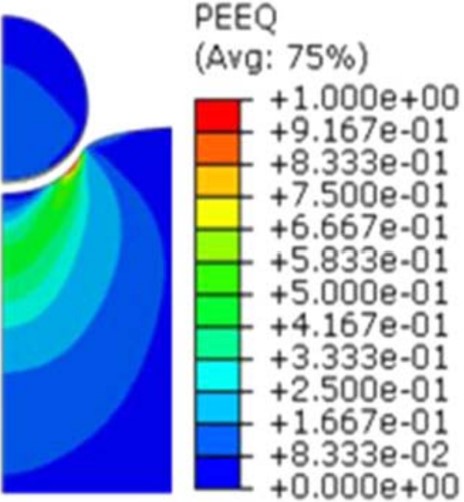
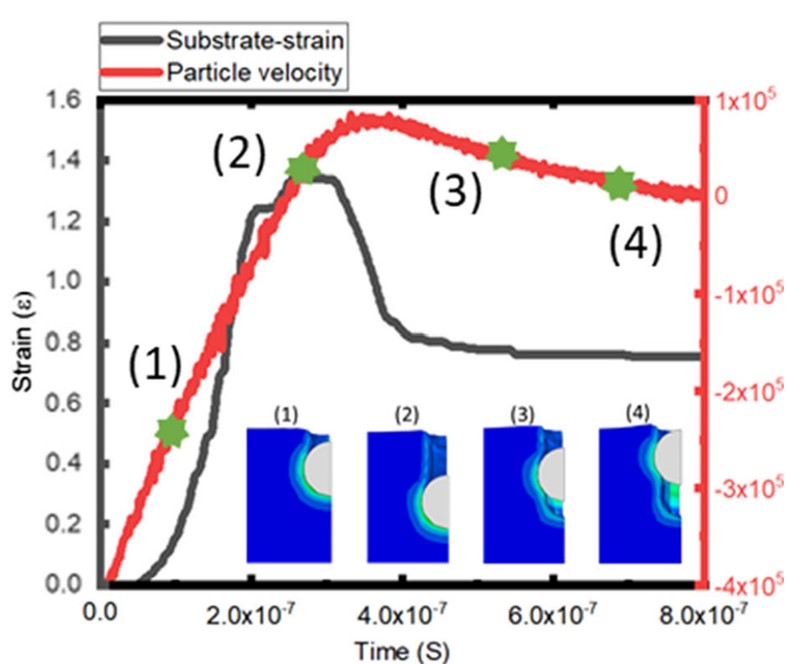 Establishing a cold spray particle deposition window on polymer substrateJung-Ting Tsai, Semih Akin, Fengfeng Zhou, and 2 more authorsJournal of Thermal Spray Technology, Nov 2021
A set of processing conditions for cold spray deposition of an embedded particle layer on a polymer substrate has been established using a dynamic impact model and verified experimentally. This research utilizes a three-network polymer model based on high strain-rate impact tests to capture the nonlinear and time-dependent response of polymer deformation during the cold spray impact with both rigid and deformable particles. The particle’s material properties, particle velocity, and particle size were systematically studied to obtain the polymer deformation’s various responses from finite element analysis. Particle impact velocity was experimentally measured with a double disk rotary system. The numerical results were mapped into diagrams and validated with the experimental results of cold spraying Cu and Al2O3 powders. This research contributes to quantifying the deposition window, which embeds but still exposes metallic/ceramic powders on a polymer substrate.

2020
-
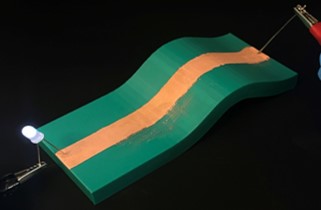 Fabrication of electrically conductive patterns on acrylonitrile-butadiene-styrene polymer using low-pressure cold spray and electroless platingSemih Akin, Jung-Ting Tsai, Min Soo Park, and 2 more authorsJournal of Micro-and Nano-Manufacturing, Nov 2020
Previous studies have shown that metallic coatings can be successfully cold sprayed (CS) onto several polymer substrates. However, the electrical performance of the cold-sprayed polymers is not generally enough to utilize them as an electronic device. In this study, an environment-friendly metallization technique has been proposed to achieve highly electrically conductive metal patterns onto polymer substrates using cold spray deposition and subsequent electroless copper plating (ECP). Copper feedstock powder was CS onto the surface of the acrylonitrile-butadiene-styrene (ABS) parts. The as-CS powders then served as the activating agent for the selective ECP to modify the surface of the polymers to be electrically conductive. A series of characterizations were conducted to investigate the morphology, analyze the surface chemistry, evaluate the electrical performance, mechanical adhesion, and mechanical strength performance of the fabricated coatings. Moreover, simple electrical circuits were presented for the ABS parts through the described method. Findings demonstrated that low-pressure cold spray copper deposition followed by the ECP processes could be used as an environmental-friendly manufacturing method of electrically conductive patterns on ABS polymer.
-
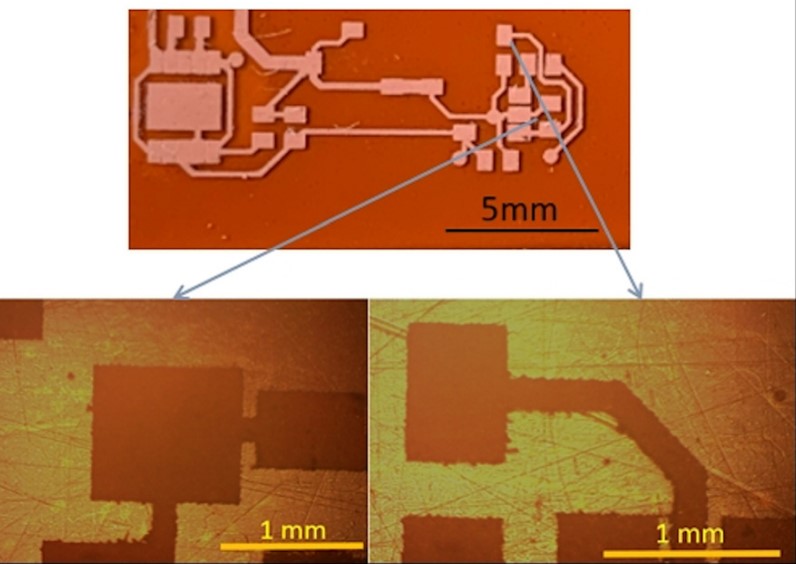 Dual regime spray deposition based laser direct writing of metal patterns on polymer substratesSemih Akin, Ted Gabor, Seunghwan Jo, and 6 more authorsJournal of Micro-and Nano-Manufacturing, Nov 2020
In recent years, the metallization of polymers has been intensely studied as it takes advantage of both plastics and metals. Laser direct writing (LDW) is one of the most widely used technologies to obtain metal patterns on polymer substrates. In LDW technology, different methods including injection-molding, drop-casting, dip coating, and spin coating are utilized for surface preparation of polymer materials prior to the laser activation process. In this study, an atomization based dual regime spray coating system is introduced as a novel method to prepare the surface of the materials for LDW of metal patterns. Copper micropatterns on the polymer surface were achieved with a minimum feature size of 30 μm, having a strong adhesion and excellent conductivity. The results show that the dual regime spray deposition system can be potentially used to obtain uniform thin film coating with relatively less material consumption on the substrates for surface preparation of laser direct metallization of polymers.

